
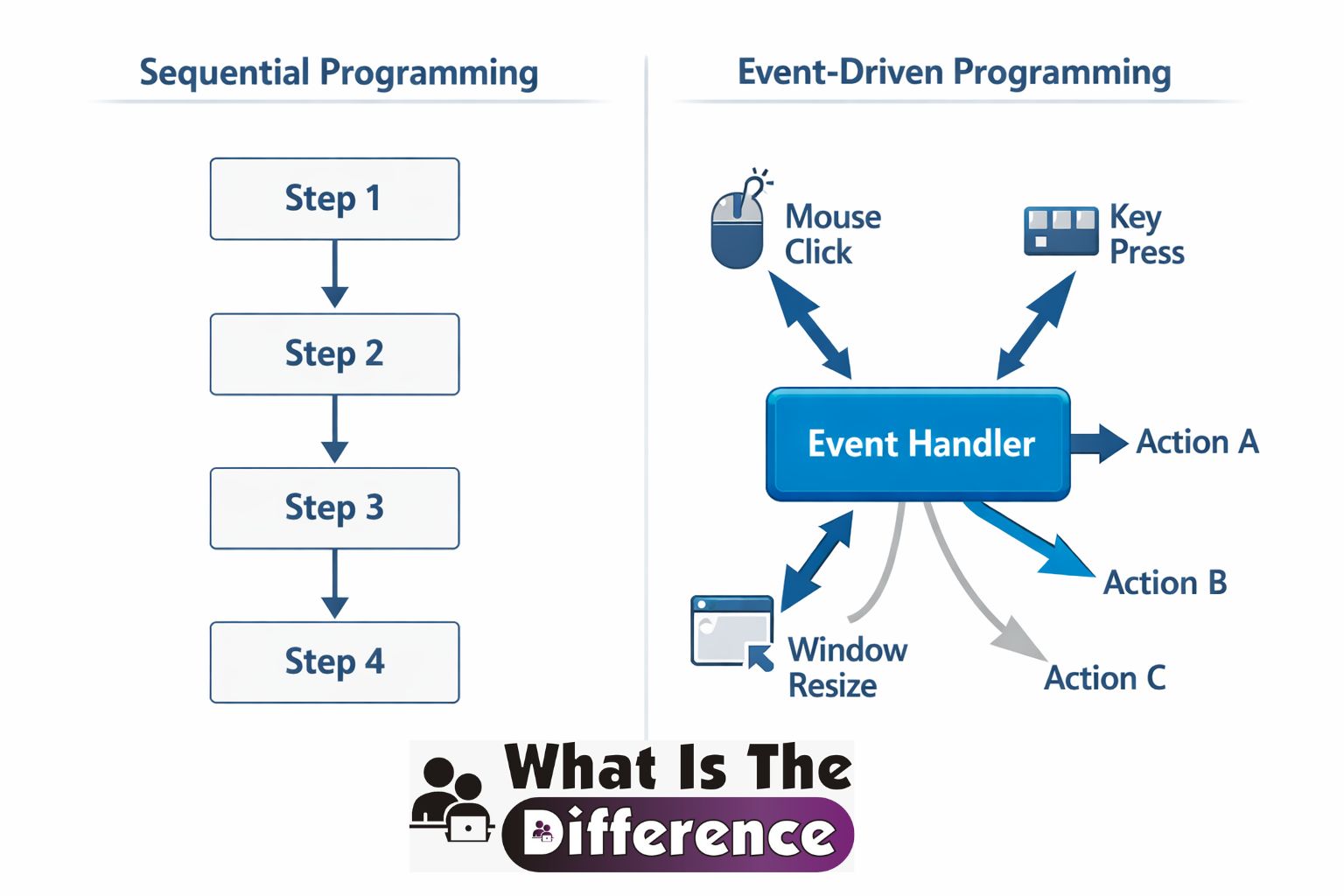
Modern software development relies on different programming models to organize how programs run and respond to tasks. Among the most fundamental concepts in programming is understanding how a program controls the order in which its instructions are executed. Two widely discussed approaches are sequential programming and event-driven programming.
If you are learning software development or exploring how applications work behind the scenes, you may wonder: what is the difference between a sequential program and an event-driven program? The answer lies mainly in how the program’s flow of execution is controlled.
In simple terms, a sequential program runs instructions one after another in a fixed order, while an event-driven program reacts to events such as user actions, system notifications, or incoming data.
Both models play important roles in modern computing. Sequential programs are commonly used for structured processes and calculations, whereas event-driven systems are essential for interactive applications such as web interfaces, mobile apps, and graphical software.
This guide explains these two programming approaches in detail, explores their characteristics, and clarifies the real difference between them.
BIO
| Feature | Sequential Program | Event-Driven Program |
|---|---|---|
| Execution Flow | Runs instructions step by step in a fixed order | Runs code when specific events occur |
| Control of Program | Controlled by the written sequence of instructions | Controlled by events like clicks or inputs |
| Program Structure | Linear and straightforward | Based on event handlers and listeners |
| User Interaction | Usually limited or none | Strongly focused on user interaction |
| Start of Execution | Begins at the first line and follows the order | Waits for events before executing actions |
| Flexibility | Less flexible due to fixed order | Highly flexible and responsive |
| Complexity | Easier to understand and design | Often more complex to manage |
| Real-Time Response | Not designed for real-time interaction | Designed to respond instantly to events |
| Common Use Cases | Scripts, calculations, batch processing | Web apps, GUIs, mobile apps |
| Code Organization | Organized as sequential steps | Organized around event functions |
| Responsiveness | Executes tasks one after another | Can react to multiple events dynamically |
| Example | A calculator program processing numbers step by step | A web page reacting to button clicks |
What Is a Sequential Program?
Understanding Sequential Programming
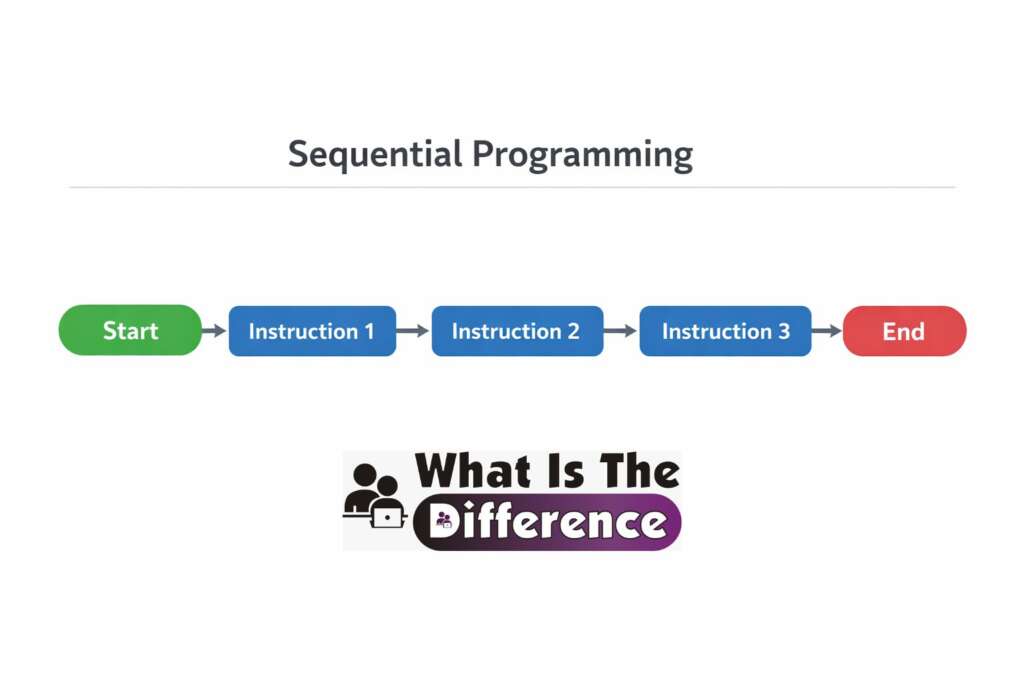
A sequential program is one in which instructions execute in a strict, predetermined order from start to finish. Each step must complete before the next step begins. This type of program follows a linear flow, meaning the sequence of operations is clearly defined and predictable.
In traditional computing, sequential programming was one of the earliest and most common ways to structure programs. It reflects the basic idea of telling the computer exactly what to do step by step.
For example, imagine a program designed to calculate the average of several numbers. The process might involve reading the numbers, summing them, dividing the total by the count, and displaying the result. Each of these actions occurs in order, with no deviation.
This step-by-step approach makes sequential programs relatively easy to understand, especially for beginners.
How Sequential Programs Work
In sequential programming, the program counter moves from one instruction to the next in a fixed sequence. The program begins at the first line of code and continues executing until the last instruction is reached.
This execution model ensures that every command runs in the exact order written by the programmer. Because of this predictable structure, sequential programs usually produce the same result every time they are run with the same input.
The execution flow can include loops and conditional statements, but the overall structure remains controlled by the program logic rather than external events.
For example, in a simple command-line script:
- The program reads user input.
- It processes the data.
- It produces an output.
- Then the program ends.
Each step occurs only after the previous step finishes.
Key Characteristics of Sequential Programs
Sequential programs have several distinct characteristics that define how they operate.
First, they follow a linear execution flow. Instructions run in the order they appear in the code.
Second, the control flow is determined entirely by the programmer. There are no unexpected interruptions caused by external triggers.
Third, sequential programs often process tasks one at a time. This means the program focuses on completing a single operation before moving to the next.
Finally, sequential programming is usually easier to debug because the order of execution is predictable.
Examples of Sequential Programming
Sequential programming appears in many areas of computing, especially in situations where a defined process must be completed step by step.
Common examples include:
Data processing scripts that analyze files or datasets.
Mathematical computation programs used in scientific calculations.
Command-line utilities that perform specific tasks such as file conversion.
Simple automation scripts used in system administration.
In these situations, the program does not need to wait for external interaction. It simply executes its instructions until the task is finished.
What Is an Event-Driven Program?
Understanding Event-Driven Programming
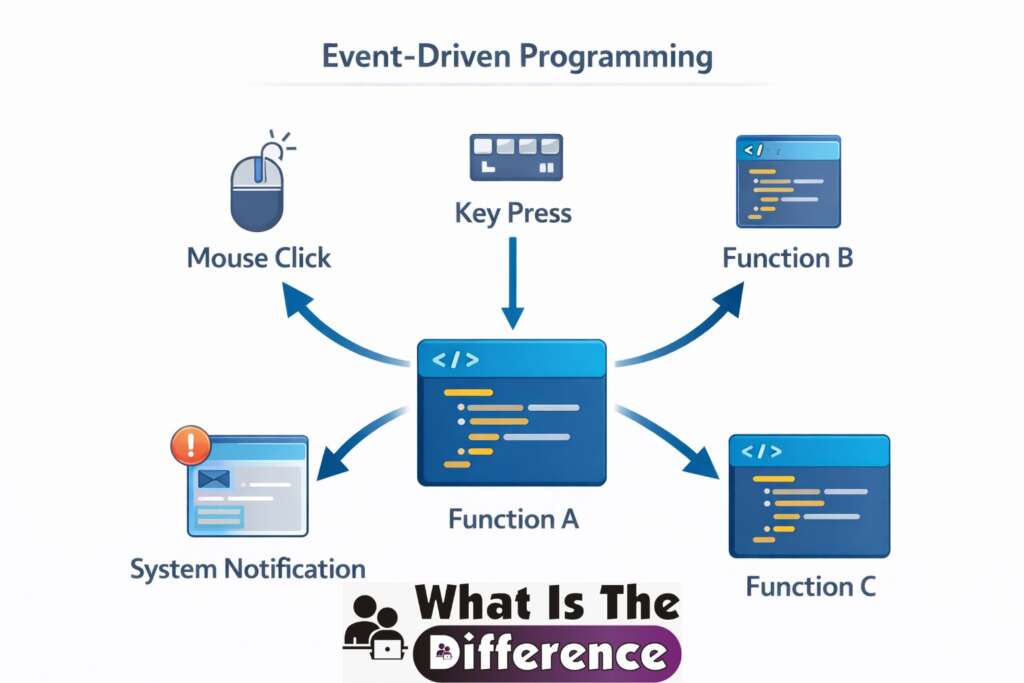
Event-driven programming follows a very different approach. Instead of executing instructions in a fixed sequence, the program waits for events to occur and then responds to them.
An event can be any action that the system detects. This might include a mouse click, keyboard input, sensor signal, system notification, or network message.
In an event-driven system, the program remains idle until an event occurs. When that event happens, a specific piece of code called an event handler is triggered to respond to it.
This model allows programs to react dynamically to different situations rather than following a single predetermined path.
How Event-Driven Programs Work
Event-driven programs typically rely on an event loop. The event loop continuously monitors incoming events and decides which function should respond to each event.
For example, in a graphical application:
A user clicks a button.
The system detects the click event.
The event loop calls the function associated with that button.
The function performs the required action.
Because events can occur at any time, the program’s execution order is not fixed. Different events may trigger different actions depending on what the user or system does.
This makes event-driven programming ideal for applications that require interaction or real-time responsiveness.
Key Characteristics of Event-Driven Programs
Event-driven programs have several defining features.
First, the execution flow is not linear. The order of operations depends on which events occur.
Second, the program relies heavily on event handlers. These functions define how the system reacts to specific events.
Third, event-driven systems often support asynchronous behavior. This means the program can handle multiple events without waiting for each one to finish.
Fourth, these programs are highly interactive and responsive to user input.
Examples of Event-Driven Programming
Event-driven programming is widely used in modern software development.
Common examples include:
Graphical user interface applications.
Web applications where user clicks trigger actions.
Mobile applications responding to touch gestures.
Games that react to player input.
Network servers handling incoming requests.
These systems must constantly respond to events happening in real time, which makes event-driven programming the ideal model.
What Is the Difference Between a Sequential Program and an Event-Driven Program?
Understanding what is the difference between a sequential program and an event-driven program? requires examining how the two approaches manage control flow and interaction.
The primary difference lies in how the program decides what to do next.
In a sequential program, the next action is determined by the order of instructions written in the code.
In an event-driven program, the next action depends on external events that trigger specific functions.
Sequential programs follow a predictable path from beginning to end. Event-driven programs, however, can change behavior depending on what events occur.
Another difference involves user interaction. Sequential programs often run independently without requiring real-time interaction. Event-driven systems are designed to respond to user actions such as clicking buttons, entering text, or touching a screen.
Program structure also differs. Sequential programs are typically organized around a clear series of procedures or steps. Event-driven programs rely on multiple independent event handlers that activate when needed.
Finally, event-driven programming tends to be more complex because developers must account for many possible event sequences. Sequential programming, on the other hand, is usually easier to follow due to its structured flow.
Advantages of Sequential Programming
Sequential programming offers several benefits, especially for tasks with clear and predictable workflows.
One advantage is simplicity. Because the instructions execute in order, the logic is easier to understand.
Another benefit is easier debugging. When something goes wrong, developers can track the issue by following the program’s execution step by step.
Sequential programs are also well suited for batch processing tasks where data must be processed in a specific sequence.
These characteristics make sequential programming a strong choice for scripts, algorithms, and calculation-based programs.
Advantages of Event-Driven Programming
Event-driven programming is powerful in situations where interaction and responsiveness are essential.
One major advantage is improved user experience. Applications can respond instantly to user input.
Another benefit is flexibility. Event-driven systems can handle many different events without forcing them into a fixed order.
Event-driven programming also supports asynchronous operations, allowing programs to remain responsive even when performing background tasks.
Because of these strengths, event-driven design is widely used in modern graphical and web-based applications.
When Should You Use Sequential Programming?
Sequential programming works best when the task involves a clearly defined process.
Examples include data analysis, file processing, mathematical computations, and automation scripts.
In these cases, the program simply needs to execute a series of operations in a specific order.
Sequential programming is also ideal for beginner programmers because it introduces the basic structure of algorithms and program flow.
When Should You Use Event-Driven Programming?
Event-driven programming becomes necessary when applications must react to unpredictable events.
This includes software with user interfaces, online services responding to network requests, and systems that monitor real-time data.
For example, a web browser cannot follow a fixed sequence because users may click links, type text, or close the window at any moment.
By using an event-driven approach, developers can design programs that remain responsive and adaptable.
Common Programming Languages That Support Both Models
Many programming languages allow developers to use both sequential and event-driven approaches depending on the application.
Examples include:
Python
JavaScript
Java
C#
C++
For instance, JavaScript is widely used for event-driven programming in web development, where actions such as clicking buttons or submitting forms trigger specific functions.
At the same time, these languages can also run sequential scripts for data processing or automation.
Real-World Examples
Understanding these concepts becomes easier when we look at real-world examples.
A simple calculator program that performs a series of calculations is typically sequential. The program reads input, processes it, and displays results in a clear order.
In contrast, a web application behaves differently. When a user clicks a button or enters data, the program responds immediately to that event.
Similarly, a desktop application such as a text editor uses event-driven programming to respond to keyboard typing, menu selections, and mouse actions.
These examples illustrate how the two programming models serve different purposes in software development.
Common Misconceptions
Some people assume that sequential programming is outdated. In reality, it remains essential for many tasks where processes must follow a strict order.
Another misconception is that event-driven programming replaces sequential programming entirely. In practice, many applications combine both approaches.
For example, an event handler might trigger a sequential process that performs calculations or data processing.
Understanding how these models complement each other is an important step in mastering software design.
Conclusion
Understanding what is the difference between a sequential program and an event-driven program? helps developers grasp one of the core concepts in programming.
Sequential programs execute instructions step by step in a fixed order, making them simple and predictable. Event-driven programs, on the other hand, respond dynamically to events such as user input or system notifications.
Both approaches are valuable and widely used in modern computing. Sequential programming remains ideal for structured processes and data processing tasks, while event-driven programming powers interactive applications such as websites, mobile apps, and graphical software.
By understanding how these two models work, programmers can choose the most appropriate design for each project and build software that is both efficient and responsive.
What Is the Difference Between Marginal Cost and Marginal Revenue? A Simple Explanation
FAQs
What is a sequential program in simple terms?
A sequential program is a type of program where instructions run one after another in a fixed order. The computer starts from the first instruction and continues step by step until the program finishes. Each task must complete before the next one begins.
What is an event-driven program?
An event-driven program is designed to respond to events such as user actions, system signals, or messages from other programs. Instead of following one fixed sequence, the program waits for events like mouse clicks, keyboard input, or network requests and then runs the appropriate code.
What is the main difference between sequential and event-driven programming?
The main difference lies in how the program’s flow is controlled. Sequential programs execute instructions in a strict order from start to finish. Event-driven programs react to events, meaning the order of execution depends on what actions occur during runtime.
Where is event-driven programming commonly used?
Event-driven programming is widely used in modern applications that require interaction. Examples include web applications, mobile apps, graphical user interface software, games, and systems that respond to real-time user input.
Can a program use both sequential and event-driven approaches?
Yes, many modern applications combine both models. An event-driven system may trigger sequential processes to perform calculations or data processing. This combination allows software to remain interactive while still executing structured tasks efficiently.