
In economics and business management, companies constantly face an important question: how much should they produce and sell to maximize profit? Producing too little may mean missing opportunities, while producing too much can lead to unnecessary costs and losses. To solve this problem, economists rely on two key concepts known as marginal cost and marginal revenue.
These ideas play a central role in microeconomics and are widely used in business strategy, pricing decisions, and production planning. By analyzing how costs and revenue change when output increases, businesses can determine the most efficient level of production.
Understanding what is the difference between marginal cost and marginal revenue? is essential for students, entrepreneurs, managers, and anyone interested in how companies make economic decisions. These concepts help explain why firms increase or decrease production, how they set prices, and how they aim to maximize profits in competitive markets.
This article provides a clear and detailed explanation of both concepts, explores their differences, and explains why the relationship between them is so important in economics.
BIO
| Feature | Marginal Cost | Marginal Revenue |
|---|---|---|
| Basic Meaning | Cost of producing one additional unit | Revenue earned from selling one additional unit |
| Focus | Production expenses | Sales income |
| Main Purpose | Measures how costs change when output increases | Measures how revenue changes when sales increase |
| Formula | Change in total cost ÷ Change in quantity | Change in total revenue ÷ Change in quantity |
| Business Role | Helps control production costs | Helps evaluate extra income from sales |
| Economic Perspective | Related to production and resources | Related to market demand and pricing |
| Impact on Profit | Higher marginal cost can reduce profit | Higher marginal revenue can increase profit |
| Decision Making | Helps decide whether producing more units is affordable | Helps decide whether selling more units is profitable |
| Graph Representation | Usually an upward-sloping curve | Often downward-sloping in many markets |
| Relation to Production | Increases when production becomes less efficient | Changes depending on market demand |
| Importance for Firms | Guides cost management in production | Guides revenue expectations from additional sales |
| Profit Maximization Role | Compared with marginal revenue to find optimal output | Compared with marginal cost to maximize profit |
Understanding Marginal Cost
Definition of Marginal Cost
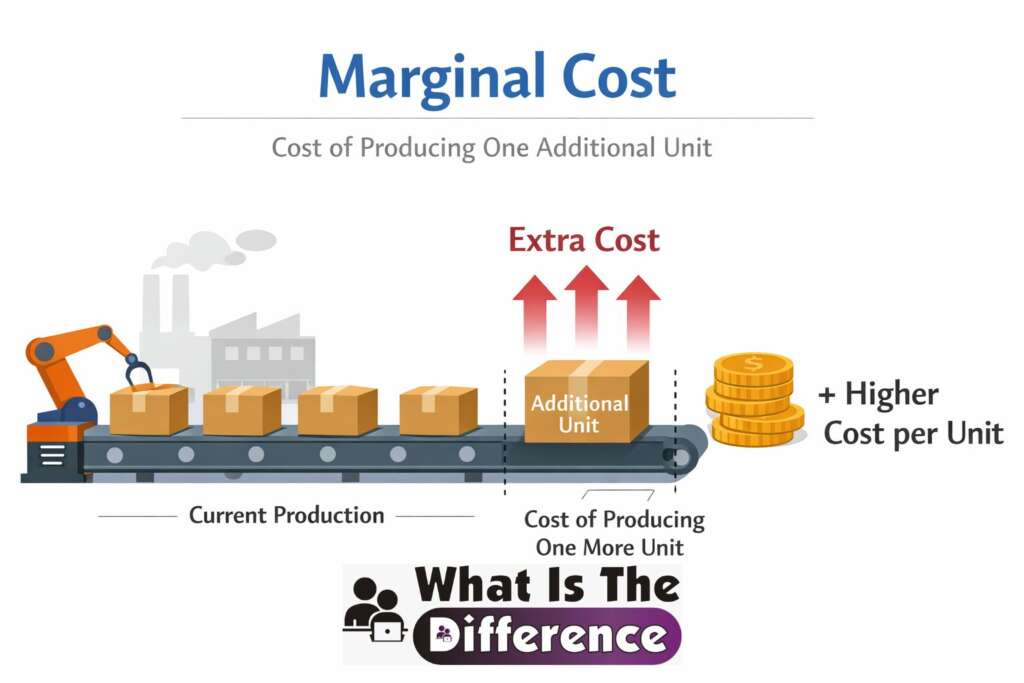
Marginal cost refers to the additional cost incurred when a company produces one more unit of a product. In simple terms, it measures how total production costs change when output increases by one unit.
Every time a firm increases production, it must spend more on materials, labor, energy, or other resources. The cost of this extra unit is what economists call marginal cost.
For example, imagine a bakery producing loaves of bread. If producing 100 loaves costs $200 and producing 101 loaves costs $202, the marginal cost of the additional loaf is $2.
Marginal cost helps businesses evaluate whether producing more goods is financially worthwhile.
How Marginal Cost Is Calculated
Marginal cost is calculated using a simple formula:
Marginal Cost = Change in Total Cost ÷ Change in Quantity
This formula shows how much the total cost increases when production rises by one unit.
For instance:
- Total cost for 50 units = $500
- Total cost for 51 units = $510
Change in cost = $10
Change in quantity = 1
Marginal Cost = $10
This means producing one extra unit costs the firm an additional $10.
Factors That Influence Marginal Cost
Several factors can affect marginal cost during production.
1. Raw material prices
If the cost of materials rises, marginal cost will also increase.
2. Labor costs
Additional workers or overtime payments can raise the cost of producing extra units.
3. Production capacity
If a company must buy new machinery or expand facilities to produce more goods, marginal cost can increase sharply.
4. Technology and efficiency
Improved technology may lower marginal costs by making production more efficient.
As production expands, marginal cost may initially fall due to efficiency improvements but eventually rise due to resource limitations.
Real-World Example of Marginal Cost
Consider a small electronics company producing smartphones.
- Cost to produce 500 phones = $100,000
- Cost to produce 501 phones = $100,180
The additional phone costs $180 to produce. This amount represents the marginal cost of the 501st phone.
By studying marginal cost, the company can decide whether producing additional phones is profitable.
Understanding Marginal Revenue
Definition of Marginal Revenue
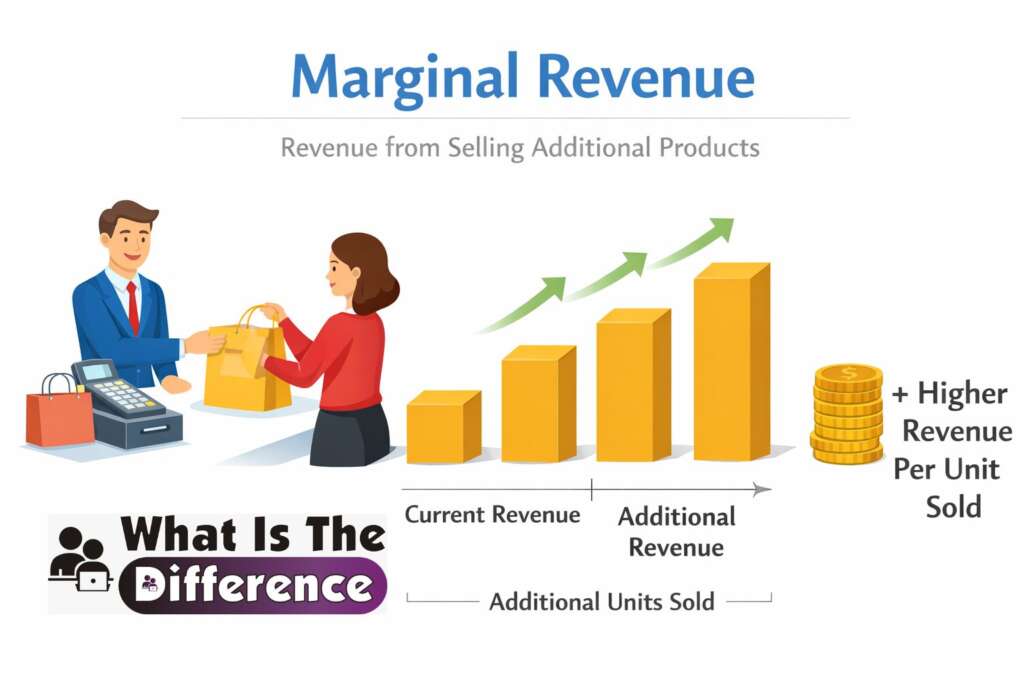
Marginal revenue refers to the additional revenue generated from selling one more unit of a product. (Wikipedia)
It shows how total revenue changes when a firm sells one additional item.
If a company sells products at a fixed price in a competitive market, marginal revenue is usually equal to that price. However, in markets where prices must be lowered to sell more units, marginal revenue may decrease as sales increase.
How Marginal Revenue Is Calculated
The formula for marginal revenue is similar to that of marginal cost:
Marginal Revenue = Change in Total Revenue ÷ Change in Quantity Sold
For example:
- Revenue from selling 20 units = $200
- Revenue from selling 21 units = $205
Change in revenue = $5
Change in quantity = 1
Marginal Revenue = $5
This means the company earns $5 from selling the additional unit.
Factors That Influence Marginal Revenue
Marginal revenue is affected by several market factors.
1. Market demand
If demand is high, companies can sell additional units without lowering prices.
2. Competition
In highly competitive markets, firms often must reduce prices to sell more products.
3. Pricing strategies
Promotions, discounts, or bundling can affect how much revenue each additional unit generates.
4. Consumer behavior
Changes in consumer preferences may increase or decrease marginal revenue.
Because of these factors, marginal revenue often declines as production increases in many real-world markets.
Example of Marginal Revenue
Imagine a clothing company selling shirts.
- Selling 100 shirts generates $2,000 in revenue.
- Selling 101 shirts generates $2,018 in revenue.
The additional shirt increases revenue by $18, meaning the marginal revenue of that shirt is $18.
Understanding marginal revenue helps firms determine whether selling more products will increase overall income.
Key Differences Between Marginal Cost and Marginal Revenue
Conceptual Difference
The fundamental difference between the two concepts lies in their focus.
Marginal cost measures the additional expense of producing one more unit.
Marginal revenue measures the additional income earned from selling one more unit.
In other words:
- Marginal cost represents production expenses.
- Marginal revenue represents sales income.
Both are essential for determining profitability.
Role in Business Decisions
Businesses constantly compare marginal cost with marginal revenue to decide how much to produce.
If the revenue earned from selling one more unit exceeds the cost of producing it, the firm benefits from expanding production.
If the cost of producing an extra unit is higher than the revenue it generates, producing that unit would reduce profit.
Therefore, companies rely on marginal analysis to guide production decisions.
Impact on Profit
Profit is calculated as:
Profit = Total Revenue – Total Cost
Marginal cost and marginal revenue help determine how profit changes when production increases.
If marginal revenue is greater than marginal cost, profit rises.
If marginal cost is greater than marginal revenue, profit falls.
Understanding this relationship allows firms to operate efficiently and avoid unnecessary losses.
Simple Comparison
| Feature | Marginal Cost | Marginal Revenue |
|---|---|---|
| Meaning | Cost of producing one more unit | Revenue from selling one more unit |
| Focus | Production expenses | Sales income |
| Formula | Change in cost ÷ Change in quantity | Change in revenue ÷ Change in quantity |
| Role | Helps control production costs | Helps evaluate additional sales income |
| Business use | Determines production efficiency | Determines revenue potential |
The Relationship Between Marginal Cost and Marginal Revenue
The Profit Maximization Rule
One of the most important principles in economics is the profit maximization rule.
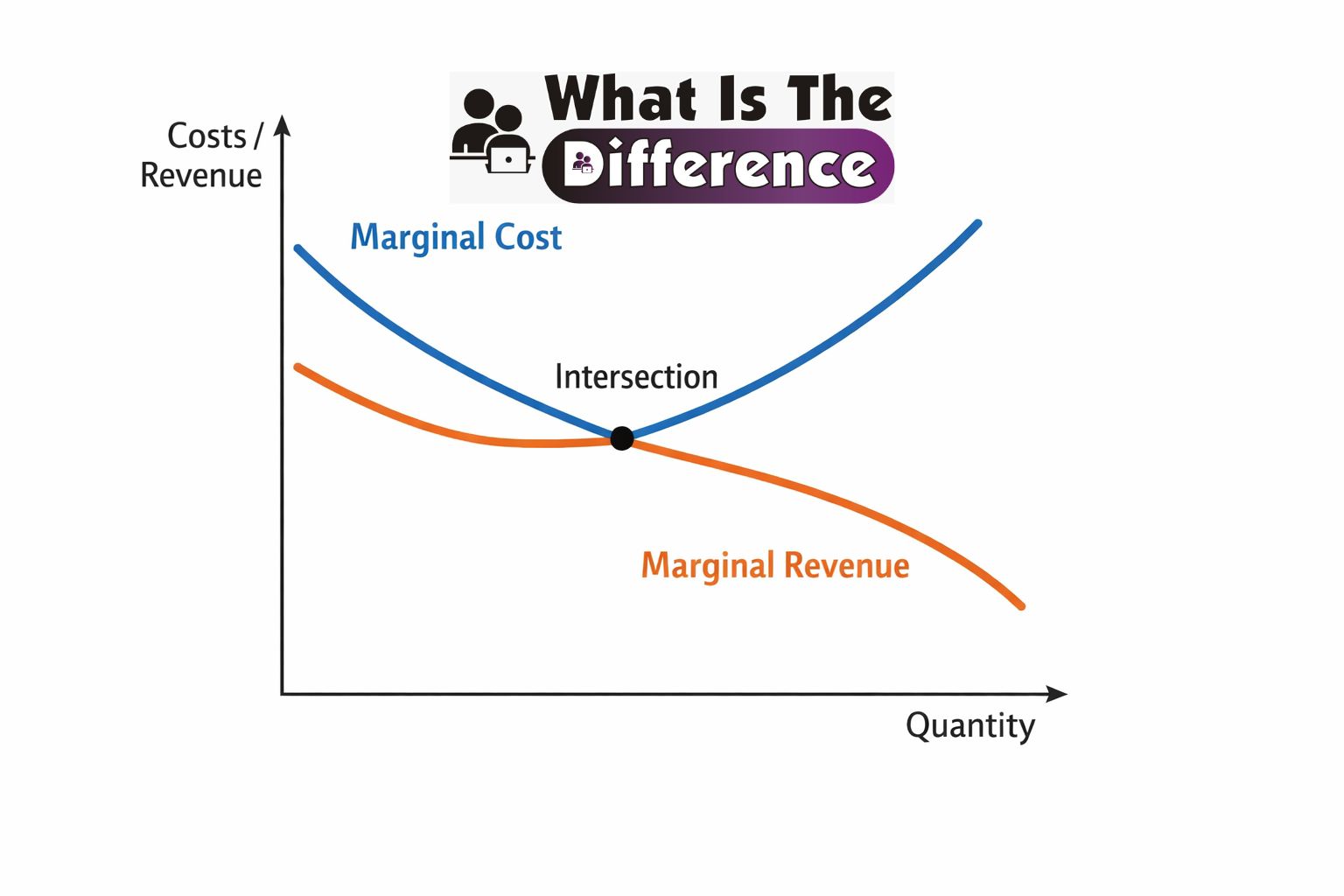
This rule states that a firm maximizes profit when marginal revenue equals marginal cost.
At this point, producing additional units neither increases nor decreases profit.
Why Businesses Follow the MC = MR Rule
When marginal revenue equals marginal cost, the firm is operating at the most efficient level of production.
Economists explain that:
- If marginal revenue exceeds marginal cost, producing more units increases profit.
- If marginal cost exceeds marginal revenue, producing extra units reduces profit.
Therefore, the optimal production level occurs where the two values are equal.
When Marginal Revenue Is Greater Than Marginal Cost
If marginal revenue is higher than marginal cost, it means the company earns more from selling an extra unit than it spends producing it.
In this situation, the firm should increase production to capture additional profit.
When Marginal Cost Is Greater Than Marginal Revenue
If marginal cost exceeds marginal revenue, producing extra units becomes unprofitable.
Each additional unit costs more to produce than it earns in revenue. When this happens, businesses should reduce output.
Practical Applications in Business
Pricing Decisions
Companies use marginal analysis to determine optimal pricing strategies.
By comparing marginal cost and marginal revenue, businesses can identify price levels that maximize profit while remaining competitive.
Production Planning
Manufacturers rely on marginal cost to determine how production levels affect costs.
If marginal costs rise significantly as production increases, the company may limit output to maintain profitability.
Cost Control
Marginal cost analysis helps firms identify inefficiencies in their production processes.
By reducing marginal costs through better technology or improved management, companies can increase profitability.
Market Strategy
Businesses also use marginal revenue analysis to evaluate consumer demand and competitive pricing strategies.
By understanding how revenue changes with sales volume, companies can adjust marketing and production strategies accordingly.
Common Misunderstandings
Many people confuse marginal cost with average cost or total cost.
Average cost measures the cost per unit across all units produced, while marginal cost focuses only on the cost of producing one additional unit.
Another misunderstanding is assuming marginal revenue always equals the selling price. In perfectly competitive markets this may be true, but in many markets companies must lower prices to sell more units, which reduces marginal revenue.
Why These Concepts Matter
Marginal cost and marginal revenue are fundamental tools in economics and business management.
They help explain how firms make rational decisions about production, pricing, and resource allocation.
Students studying economics learn these concepts to understand how markets function. At the same time, businesses rely on them to manage operations, improve efficiency, and maximize profits.
Without analyzing marginal changes in cost and revenue, companies would struggle to determine the most effective production strategy.
Conclusion
Understanding what is the difference between marginal cost and marginal revenue? is essential for anyone studying economics or managing a business.
Marginal cost represents the additional cost of producing one more unit, while marginal revenue represents the additional income earned from selling that unit. By comparing these two values, firms can determine whether increasing or decreasing production will improve profitability.
The relationship between marginal cost and marginal revenue forms the basis of the profit maximization rule, which states that businesses achieve maximum profit when the two values are equal.
In real-world markets, companies constantly analyze these metrics to make better decisions about pricing, production, and competition. Whether in manufacturing, retail, or services, marginal analysis remains one of the most powerful tools for understanding economic behavior and guiding business success.
What Is a Major Difference Between Retail Banks and Credit Unions? Explained Clearly
FAQs
1. What is marginal cost in simple terms?
Marginal cost is the additional expense a business faces when it produces one more unit of a product. It helps companies understand how production costs change as output increases.
2. What does marginal revenue mean?
Marginal revenue refers to the extra income a company earns from selling one additional unit of a product or service. It shows how total revenue changes when sales increase.
3. Why is the relationship between marginal cost and marginal revenue important?
The relationship between these two concepts helps businesses determine the most profitable production level. Profit is usually maximized when marginal revenue is equal to marginal cost.
4. Can marginal revenue be lower than the selling price?
Yes, in many markets marginal revenue can be lower than the selling price. This often happens when businesses must reduce prices slightly to sell additional units.
5. Why do economists compare marginal cost and marginal revenue?
Economists compare these two values because they help explain how firms make decisions about production, pricing, and resource allocation in competitive markets.