The terms immigration and emigration are often used in everyday conversations, news reports, and academic discussions. Yet, many people still confuse them or use them interchangeably. At first glance, both words seem to describe the same idea, people moving from one country to another.
However, there is a clear and important distinction between the two. Understanding this difference is not just about language. It also helps you better understand global movement, population changes, and real-life migration stories.
In this guide, we will explore what is the difference between immigration and emigration in a clear, simple, and practical way. By the end, you will be able to use both terms correctly and confidently.
Quick Comparison Table
| Feature | Immigration | Emigration |
|---|---|---|
| Basic Meaning | Entering a country | Leaving a country |
| Direction | Into a country | Out of a country |
| Perspective | Destination country | Home country |
| Focus | Arrival | Departure |
| Example | Moving to Canada | Leaving Pakistan |
| Keyword Tip | “In” | “Exit” |
| Usage Context | Receiving country view | Sending country view |
| Role of Person | Immigrant | Emigrant |
| Movement Type | Coming in | Going out |
| Common Purpose | Settlement or work | Seeking better opportunities |
| Relationship | Opposite of emigration | Opposite of immigration |
| Same Person? | Yes | Yes |
What Does Immigration Mean?

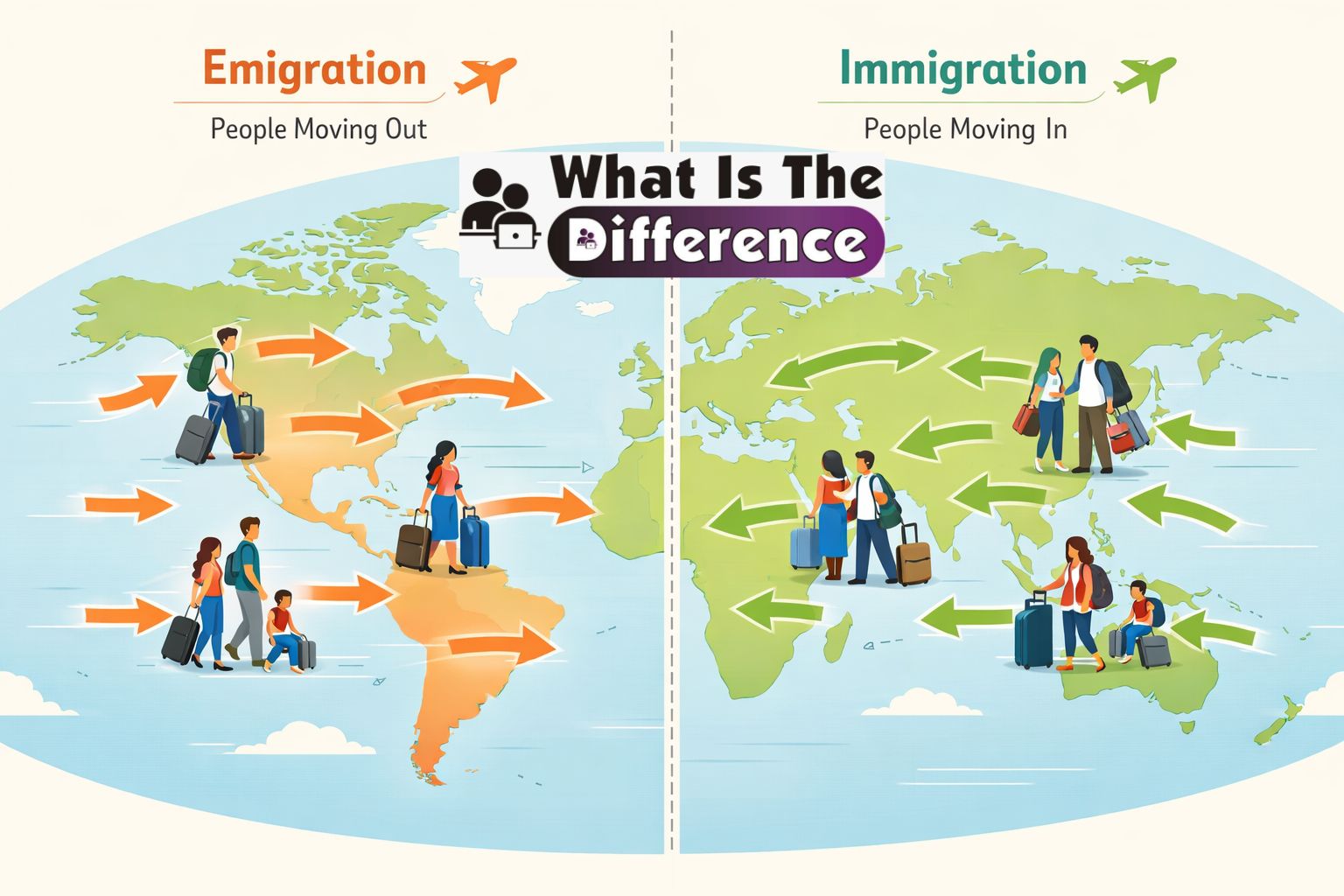
Immigration refers to the act of moving into a new country with the intention of living there, either permanently or for a long period.
When a person immigrates, they are entering a country that is not their place of birth. The focus here is on arrival. It is about coming into a new place and becoming part of that society.
People immigrate for many reasons. Some move for better job opportunities, while others seek education, safety, or to reunite with family members. In many cases, immigration is associated with long-term settlement and building a new life.
For example, if someone moves from India to Canada to live and work, they are considered an immigrant in Canada. The key idea is that immigration is about entering a country.
What Does Emigration Mean?

Emigration is the opposite side of the same process. It refers to leaving one’s home country to settle in another country.
Here, the focus is on departure. It is about going out of a country rather than entering one.
People emigrate for similar reasons as immigration, such as better economic opportunities, education, or personal safety. In some cases, individuals leave due to political instability or limited resources in their home country.
For example, if a person leaves Pakistan to live in the United Kingdom, they are emigrating from Pakistan. The same individual will be an immigrant in the UK.
So, emigration is about leaving your country, while immigration is about arriving in another.
The Core Difference Between Immigration and Emigration
At its core, the difference between these two terms comes down to perspective.
Immigration means coming into a country. Emigration means going out of a country. (Dictionary.com)
Both terms describe the same movement, but from different viewpoints. One focuses on the destination, while the other focuses on the origin.
A simple way to understand this is through a single journey. If a person moves from one country to another, they are both an emigrant and an immigrant at the same time. (study.com)
They are an emigrant from the country they leave, and an immigrant in the country they enter.
This dual perspective is the key to understanding what is the difference between immigration and emigration.
Immigration vs Emigration: Side-by-Side Understanding
While both terms are closely connected, they are not interchangeable.
Immigration focuses on the receiving country. It describes people coming in and becoming part of a new society.
Emigration focuses on the home country. It describes people leaving and moving elsewhere.
Think of it this way. Immigration is about arrival. Emigration is about departure.
Understanding this simple distinction helps avoid confusion in everyday language and writing.
Real-Life Examples to Understand the Difference
Let’s look at a practical example.
Imagine a person named Ali who moves from Pakistan to Australia for work. From Pakistan’s point of view, Ali has emigrated because he left the country. From Australia’s point of view, he has immigrated because he entered the country.
This means the same movement can be described in two different ways depending on perspective.
Another example could be a student moving abroad for education. They are emigrating from their home country and immigrating to the country where they will study.
These examples show that both terms are connected, but they highlight different parts of the journey.
Why People Confuse Immigration and Emigration
There are several reasons why these terms are often misunderstood.
First, they sound very similar. The words “immigration” and “emigration” differ by just one letter, which makes them easy to mix up.
Second, both involve moving between countries. Without understanding the perspective, it is natural to assume they mean the same thing.
Third, people often focus on the action of moving rather than the direction of movement. But direction is exactly what separates the two terms.
Once you understand that one is about entering and the other is about leaving, the confusion starts to disappear.
How to Remember the Difference Easily
A simple memory trick can make things much easier.
Think of “immigration” as “in.” Immigration means moving into a country.
Think of “emigration” as “exit.” Emigration means leaving a country.
This small association can help you remember the difference quickly, even in conversation or writing.
Another way to remember is by thinking about perspective. Ask yourself, am I talking about leaving or arriving? The answer will guide you to the correct term.
Key Factors That Shape Immigration and Emigration
People do not move between countries without reasons. Several key factors influence both immigration and emigration.
Economic opportunities are one of the main drivers. People often leave countries with fewer job opportunities and move to places where they can earn a better living.
Education is another important factor. Many students travel abroad to study and gain international experience.
Political and social conditions also play a role. People may leave countries facing conflict, instability, or limited freedoms.
Family connections can also influence movement. Many individuals immigrate to join relatives already living in another country.
These factors are often described as “push” and “pull” forces. People are pushed out of one place and pulled toward another.
Impact on Countries and Society
Immigration and emigration have significant effects on both individuals and countries.
For receiving countries, immigration can bring economic growth, cultural diversity, and new skills. It can also create challenges, such as the need for resources, housing, and integration.
For home countries, emigration can reduce population pressure and unemployment. However, it can also lead to the loss of skilled workers, often referred to as “brain drain.”
In some cases, emigrants send money back home, supporting their families and contributing to the economy.
Overall, both immigration and emigration shape societies in meaningful ways, influencing culture, economy, and demographics.
Common Misconceptions
One common misconception is that immigration and emigration mean the same thing. While they are related, they describe opposite directions.
Another misunderstanding is that a person can only be one or the other. In reality, a person can be both an emigrant and an immigrant at the same time.
Some people also think these terms only apply to permanent moves. While they are often used for long-term relocation, they can also apply to extended stays in another country.
Understanding these misconceptions helps clarify what is the difference between immigration and emigration in everyday use.
Conclusion
Understanding what is the difference between immigration and emigration becomes simple once you focus on perspective.
Immigration is about entering a country. Emigration is about leaving one. Both describe the same journey, but from different viewpoints.
These terms are more than just definitions. They reflect real human experiences, movement, and change. People move for better lives, opportunities, safety, and connection.
The next time you hear these words, remember this simple idea. Immigration is coming in. Emigration is going out.
With that clarity, you will never confuse them again.
What Is the Difference Between a Crow and a Raven? A Simple Guide
FAQs
What is the main difference between immigration and emigration?
The main difference is direction. Immigration means moving into a country, while emigration means leaving your home country to live somewhere else.
Can one move be both immigration and emigration?
Yes, the same move can be described in both ways. A person emigrates from their home country and immigrates to the new country at the same time.
Which term is used when entering a country?
Immigration is the correct term when someone enters and settles in a new country. It focuses on arrival and becoming part of that place.
Why do people often confuse immigration and emigration?
People confuse them because the words sound similar and both describe movement between countries. The key difference lies in perspective, whether someone is leaving or arriving.
How can I remember the difference easily?
A simple trick is to think of “immigration” as “in” and “emigration” as “exit.” This helps you quickly recall which term to use.