

Weather reports often mention humidity, but the number people really feel is often the dew point. That is why a day with 60% humidity can feel pleasant in one season and sticky in another. The air may look the same, but the amount of moisture your body is dealing with can be very different.
Understanding dew point vs humidity helps you read weather forecasts more accurately, manage indoor comfort, protect your home from moisture problems, and understand why some days feel heavy, damp, or exhausting even when the temperature does not look extreme.
| Feature | Dew Point | Humidity |
|---|---|---|
| Definition | Temperature where air becomes saturated | Amount of moisture in the air |
| Type | Absolute measure | Relative measure |
| Unit | °C or °F | Percentage (%) |
| Temperature Dependence | Not dependent on current temperature | Strongly depends on temperature |
| Measures | Actual moisture content | Moisture relative to capacity |
| Comfort Indicator | More accurate | Less reliable alone |
| Stability | Remains fairly stable | Changes with temperature |
| Usage | Outdoor comfort and weather analysis | Indoor air control and general use |
| Interpretation | Easy to understand directly | Needs temperature context |
| Effect on Body | Directly impacts sweat evaporation | Indirect effect via temperature |
| Role in Forecasting | Indicates moisture level and fog/rain potential | Shows saturation level |
| Common Confusion | Less commonly misunderstood | Often misinterpreted by users |
What Humidity Means
Humidity describes water vapor in the air. Water vapor is invisible, but it affects how the air feels, how clouds form, how sweat evaporates, and how comfortable a room or outdoor space feels.
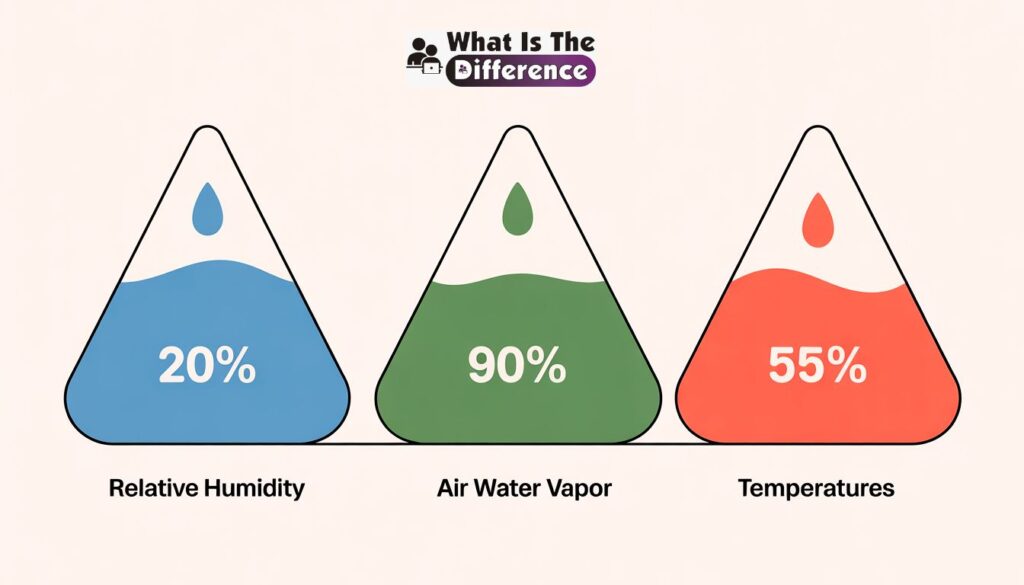
When most people say “humidity,” they usually mean relative humidity. Relative humidity is shown as a percentage. It tells you how close the air is to being saturated with moisture at the current temperature.
For example, 70% relative humidity means the air is holding 70% of the moisture it can hold at that temperature. At 100% relative humidity, the air is saturated, which means it cannot hold much more water vapor without condensation forming.
The important detail is this: relative humidity depends heavily on temperature. Warm air can hold more moisture than cold air. So the same percentage does not always mean the same amount of water vapor is present.
What Dew Point Means
Dew point is the temperature at which air becomes saturated and water vapor begins to condense into liquid water. This is why dew forms on grass, car windows, or outdoor surfaces when the air cools enough overnight.

The National Weather Service defines dew point as the temperature air must be cooled to, at constant pressure, for relative humidity to reach 100%. At that point, moisture can begin coming out of the air as dew, fog, clouds, or precipitation.
Unlike relative humidity, dew point is expressed in degrees, usually Fahrenheit or Celsius. More importantly, it gives a clearer idea of the actual moisture content in the air.
That is why meteorologists often say dew point is a better comfort indicator than relative humidity. A higher dew point means more moisture is present in the air, and your body usually feels that as stickiness, heaviness, or mugginess.
The Main Difference
The simplest way to understand dew point vs humidity is this:
Humidity tells you how full the air is compared with how much it could hold at that temperature. Dew point tells you how much moisture is actually in the air.
Relative humidity changes as temperature changes. Dew point is more stable because it reflects the real moisture amount.
This is why a cool morning can show 95% humidity and still feel comfortable, while a hot afternoon with 60% humidity can feel miserable. The afternoon air may contain far more moisture even though the percentage looks lower.
NOAA gives a helpful example: an 80°F day with 50% relative humidity can feel much more humid than a 30°F day with 100% relative humidity because the warmer air has a higher dew point and more actual moisture.
Why Relative Humidity Can Be Misleading
Relative humidity is useful, but it can trick people because it is relative to temperature.
Imagine two days:
Day one: 50°F with 90% humidity
Day two: 90°F with 55% humidity
At first glance, day one looks more humid. But day two will probably feel far stickier because warm air can hold much more water vapor. Even with a lower percentage, the total moisture in the air may be much higher.
That is the weakness of relative humidity. It tells you saturation level, not total moisture.
The National Weather Service explains that dew point gives a quicker idea of moisture content, while relative humidity cannot be understood properly without also knowing the air temperature.
Why Dew Point Feels More Personal
Dew point is often the number that matches human comfort best.
When dew point is low, sweat evaporates more easily, and the air feels drier. When dew point is high, sweat evaporates more slowly, and the body struggles to cool itself.
This is why humid heat feels so draining. It is not just the heat; it is the moisture blocking your natural cooling system.
The National Weather Service explains that high relative humidity slows evaporation from the body, making people feel warmer. As temperature and humidity rise together, the heat index also rises.
A practical dew point comfort guide looks like this:
Below 50°F: dry and comfortable
50°F to 60°F: pleasant for most people
60°F to 65°F: slightly humid
65°F to 70°F: noticeably sticky
70°F to 75°F: uncomfortable and muggy
Above 75°F: oppressive and potentially stressful
These ranges are not strict rules, because wind, sunshine, activity level, clothing, and personal tolerance also matter. But for daily comfort, dew point usually tells the story better than relative humidity.
Dew Point and Condensation
Dew point also explains why condensation appears.
When warm, moist air touches a cooler surface, the air near that surface can cool down to its dew point. Once that happens, water vapor turns into liquid droplets.
That is why you may see water on the outside of a cold glass, fog on bathroom mirrors, moisture on windows, or dew on grass in the morning.
Condensation is not random. It is a sign that air has cooled enough to reach saturation. NOAA explains that dew point marks the temperature where water vapor turns into liquid droplets through condensation.
This matters indoors, too. If condensation repeatedly appears on windows, walls, or pipes, it may point to excess indoor moisture, poor ventilation, or cold surfaces.
Humidity Inside the Home
Indoors, relative humidity becomes especially useful because it helps manage comfort, health, and building conditions.
The Environmental Protection Agency recommends keeping indoor humidity below 60%, ideally between 30% and 50%, to help reduce moisture problems and mold risk.
Too little indoor humidity can make air feel dry. It may irritate skin, lips, throat, or nasal passages. Too much humidity can make rooms feel stuffy and may encourage mold growth, dust mites, musty smells, and condensation.
For most homes, a simple hygrometer can help track indoor humidity. Air conditioners, bathroom exhaust fans, kitchen ventilation, dehumidifiers, and proper insulation can all help control moisture.
Dew Point Outdoors
Outdoors, dew point is often the better number to check before planning your day.
A temperature of 85°F can feel fairly comfortable with a dew point near 50°F. But the same 85°F can feel exhausting with a dew point above 70°F. The thermometer shows the same temperature, but your body feels a completely different atmosphere.
High dew points also affect nighttime comfort. Moist air does not cool as easily as dry air, so warm, humid nights can stay uncomfortable for longer. That is why summer nights in humid regions may feel heavy even after the sun goes down.
Dew point also helps forecast fog, clouds, and rain potential. When the air temperature gets close to the dew point, the air is nearing saturation. NOAA notes that the closer temperature and dew point are, the greater the moisture in the atmosphere and the higher the chance of cloud or precipitation development.
Humidity and Heat Stress
Humidity is not just about comfort. It can also affect safety.
When the air is humid, sweat does not evaporate as efficiently. Since evaporation is one of the body’s main cooling methods, humid weather can increase heat stress.
The CDC lists high temperature and humidity among the risk factors for heat-related illness, along with direct sun exposure, limited air movement, dehydration, physical exertion, and certain health conditions.
This is why athletes, outdoor workers, older adults, children, and people with certain medical conditions need to pay close attention to hot, humid weather. A day may not look dangerous by temperature alone, but high moisture can make it harder for the body to recover.
Dew Point vs Humidity in Weather Apps
Many weather apps show temperature, relative humidity, dew point, and “feels like” temperature. Each number has a purpose.
Temperature tells you how hot or cold the air is.
Relative humidity tells you how close the air is to saturation.
Dew point tells you how much moisture is actually present.
Heat index estimates how hot it feels when humidity affects cooling.
For comfort, check dew point first. For indoor air control, check relative humidity. For heat safety, check heat index and local alerts.
The mistake many people make is looking only at relative humidity. That number is incomplete without temperature. A high humidity percentage on a cool day may not feel humid at all. A moderate humidity percentage on a hot day can feel oppressive.
Common Misunderstandings
One common misunderstanding is that 100% humidity always means rain. It does not. It means the air is saturated at that temperature. Rain depends on larger weather conditions, cloud development, lifting air, and enough condensed moisture to fall.
Another misunderstanding is that low relative humidity always means dry air. Not always. On a hot day, even moderate relative humidity can represent a lot of water vapor.
A third misunderstanding is that dew point and humidity are the same thing. They are related, but not identical. Dew point is a temperature. Relative humidity is a percentage. Dew point is usually better for judging outdoor mugginess, while relative humidity is more common for indoor comfort and moisture control.
Easy Example
Think of air like a sponge.
Warm air is like a bigger sponge. It can hold more water vapor. Cold air is like a smaller sponge. It holds less.
Relative humidity tells you how full the sponge is as a percentage. Dew point tells you more about how much water is actually in the sponge.
A small sponge that is 90% full may still contain less water than a large sponge that is 60% full. That is why relative humidity alone can be confusing.
Which One Should You Trust?
For outdoor comfort, dew point is usually more useful.
For indoor air quality, relative humidity is usually more practical.
For weather forecasting, both matter. Meteorologists use temperature, dew point, relative humidity, pressure, wind, and other data together to understand what the atmosphere is doing.
So the best answer is not that one number is always better. The better answer is: use the right number for the right situation.
Check dew point when you want to know how sticky the air will feel. Check relative humidity when you want to manage moisture indoors. Check heat index when heat safety matters.
Final Thoughts
The difference between dew point vs humidity comes down to actual moisture versus relative moisture.
Humidity, especially relative humidity, tells you how close the air is to saturation at the current temperature. Dew point tells you the temperature where saturation happens and gives a stronger sense of how much moisture is really in the air.
That is why dew point often explains comfort better. It helps answer the question people actually care about: “Why does the air feel so sticky today?”
Once you understand both numbers, weather forecasts become easier to read. You can better judge outdoor comfort, manage indoor moisture, prevent condensation, and recognize when heat and humidity may become more than just uncomfortable.
FAQs: Dew Point vs Humidity
1. Is dew point more important than humidity?
Dew point is usually more useful for understanding how the air actually feels outdoors. It reflects the real amount of moisture in the air, while humidity depends on temperature and can sometimes give a misleading impression of comfort.
2. What dew point feels uncomfortable?
Most people start to feel discomfort when the dew point rises above 65°F (around 18°C). When it goes above 70°F (21°C), the air often feels sticky and heavy, making it harder for the body to cool down.
3. Can humidity be high but dew point low?
Yes, this can happen in cooler weather. The air can have high relative humidity because it is near saturation, but the actual moisture content is still low, which keeps the dew point low and the air feeling comfortable.
4. Why does high humidity feel hotter?
High humidity slows down the evaporation of sweat from your skin. Since evaporation helps cool the body, reduced evaporation makes you feel warmer than the actual air temperature.
5. How can I check dew point and humidity easily?
Most weather apps and forecasts show both dew point and relative humidity. You can also use a simple indoor hygrometer to monitor humidity levels at home and adjust your environment for better comfort.