
Introduction
Choosing the right insulation can quietly shape how comfortable your home feels year-round and how much you spend on energy bills. If you’ve been comparing options, you’ve probably come across a common question: what’s the difference between R11 and R13 insulation?
At first glance, the numbers seem close. But even a small difference in insulation value can affect performance, cost, and long-term efficiency. In this guide, you’ll get a clear, practical breakdown of how R11 and R13 insulation compare, where each works best, and how to decide which one makes sense for your home.
| Feature | R11 Insulation | R13 Insulation |
|---|---|---|
| R-Value | Lower thermal resistance | Higher thermal resistance |
| Heat Flow Resistance | Allows more heat transfer | Reduces heat transfer better |
| Thickness | Thinner | Slightly thicker |
| Density | Less dense | More dense |
| Energy Efficiency | Moderate | Better overall efficiency |
| Cost | More affordable | Slightly more expensive |
| Best Use Area | Interior walls, low-demand areas | Exterior walls, main insulation |
| Climate Suitability | Mild climates | Moderate to colder climates |
| Comfort Level | Basic temperature control | Improved indoor comfort |
| Availability | Less commonly used today | Widely available and standard |
| Building Code Compliance | May not meet some codes | Meets most standard requirements |
| Long-Term Value | Lower upfront savings | Better long-term energy savings |
What Do R11 and R13 Insulation Mean?
Understanding R-Value in Simple Terms
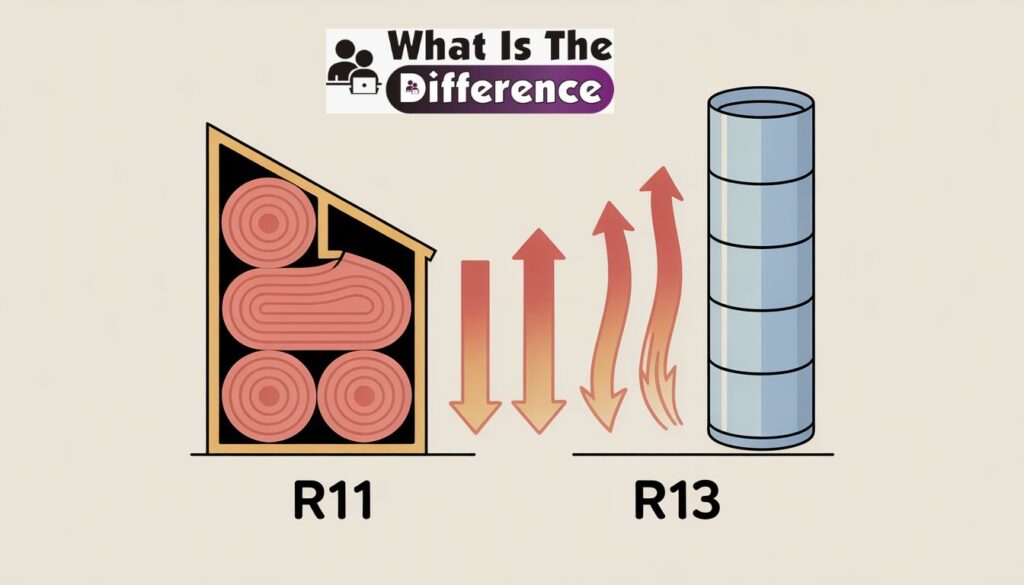
Before comparing them, it helps to understand what the numbers mean. The “R” in R11 and R13 stands for thermal resistance, or how well a material resists heat flow.
- Higher R-value = better insulation performance
- Lower R-value = less resistance to heat transfer
In simple terms, insulation with a higher R-value does a better job of keeping heat inside during winter and outside during summer.
If you want a deeper technical explanation, you can refer to this overview of R-value from a trusted source:
Common Materials Used in R11 and R13
Both R11 and R13 insulation are typically available in similar materials:
- Fiberglass batts (most common and affordable)
- Mineral wool (better for sound and fire resistance)
- Foam-based options (less common at these R-values)
The material doesn’t change the R-value itself, but it can affect durability, moisture resistance, and ease of installation.
What’s the Difference Between R11 and R13 Insulation?
Insulation Performance and Thermal Resistance
The core difference comes down to performance.
- R11 insulation provides moderate thermal resistance
- R13 insulation offers about 18% more resistance to heat flow
While that might not sound like a huge jump, it can make a noticeable difference in temperature stability and energy efficiency, especially in exterior walls.
Thickness and Fit in Walls
Both R11 and R13 are designed to fit standard 2×4 wall cavities, but there’s a slight difference:
- R11 is thinner and less dense
- R13 is slightly thicker and more tightly packed
This added density is what gives R13 its higher insulating power.
Energy Efficiency Impact
In real-world terms:
- R13 insulation helps reduce heat loss and gain more effectively
- This can translate to lower heating and cooling costs over time
However, the difference isn’t dramatic. Think of it as a steady improvement, not a dramatic upgrade.
Cost Comparison
Cost is often where people hesitate.
- R11 is cheaper upfront
- R13 costs slightly more per square foot
That said, the price difference is usually modest, and many homeowners find that R13 pays off through better efficiency over time.
Availability and Installation
R13 is generally more widely used today, which means:
- Easier to find in stores
- More commonly recommended by contractors
- Often preferred for modern building standards
Both types are relatively easy to install, especially in batt form, making them suitable for DIY projects.
R11 vs R13 Insulation: Which One Is Better for Your Home?
Best Choice for Interior Walls
For interior walls, thermal insulation isn’t always the main goal.
- R11 is often sufficient for interior partitions
- It can help with basic sound dampening
If you’re insulating between rooms rather than against outdoor temperatures, R11 can be a cost-effective choice.
Best Choice for Exterior Walls
For exterior walls, performance matters more.
- R13 is typically the better option
- It provides improved protection against outdoor temperature changes
In many regions, R13 is considered the minimum standard for exterior wall insulation.
Climate Considerations
Your local climate plays a big role:
- Warmer climates: R11 may be acceptable in some cases
- Colder climates: R13 is usually preferred (or even higher R-values)
Always check your local building codes, as they often specify minimum requirements.
How to Choose Between R11 and R13 Insulation
Making the right choice doesn’t have to be complicated. Here’s a simple step-by-step approach.
Step 1: Check Your Wall Depth
Most residential walls are built with:
- 2×4 studs → compatible with both R11 and R13
- 2×6 studs → typically require higher R-values (like R19 or more)
Make sure your insulation fits properly without being compressed.
Step 2: Consider Your Climate Zone
Think about how extreme your weather is:
- Mild climate → R11 may work in limited cases
- Moderate to cold climate → R13 is usually the safer choice
Better insulation helps maintain indoor comfort with less energy use.
Step 3: Set Your Budget
If you’re working with a tight budget:
- R11 can reduce upfront costs
But if you’re thinking long-term:
- R13 offers better value through energy savings
Step 4: Review Local Building Codes
Building codes often require minimum R-values for safety and efficiency.
- Many areas require at least R13 for exterior walls
- Ignoring codes can lead to costly fixes later
Real-Life Examples and Use Cases
Small Renovation Projects
If you’re insulating a small area like a single room or partition wall:
- R11 can be a practical, budget-friendly option
- Works well where energy performance isn’t critical
New Home Construction
For new builds:
- R13 is usually the standard choice
- It aligns better with modern energy efficiency expectations
Builders rarely choose R11 unless there’s a specific reason.
Garage or Basement Insulation
These spaces vary depending on use:
- Unheated garage → R11 may be enough
- Finished basement → R13 provides better comfort
Tips and Best Practices for Better Insulation
Avoid Gaps and Compression
Even the best insulation won’t perform well if installed poorly.
- Don’t leave gaps
- Don’t compress the material
- Ensure a snug fit between studs
Proper installation matters more than a small R-value difference.
Combine Insulation with Air Sealing
Insulation alone doesn’t stop air leaks.
- Seal cracks and gaps around windows, doors, and outlets
- Use caulk or foam where needed
This step can dramatically improve overall efficiency.
Don’t Ignore Moisture Control
Moisture can reduce insulation performance and cause damage.
- Use vapor barriers where needed
- Ensure proper ventilation
This is especially important in humid or cold climates.
Common Mistakes to Avoid
- Choosing based only on price instead of long-term value
- Ignoring local building codes and requirements
- Installing insulation incorrectly, reducing effectiveness
- Overestimating the difference between R11 and R13
The key is balance performance, cost, and proper installation all matter.
What’s the Difference Between Highlander and Grand Highlander?
FAQs About R11 vs R13 Insulation
Is R13 insulation worth the extra cost over R11?
In most cases, yes. The added efficiency can lead to better comfort and lower energy bills, making it a worthwhile upgrade.
Can I use R11 insulation in exterior walls?
You can, but it’s often not recommended. Many building codes require at least R13 for exterior walls.
Does R13 insulation significantly lower energy bills?
The savings aren’t dramatic, but they are noticeable over time especially in climates with extreme temperatures.
What insulation is best for 2×4 walls?
R13 is generally considered the standard choice for 2×4 walls due to its better thermal performance.
Can I layer R11 insulation to match R13?
Technically yes, but it’s not ideal. Properly sized insulation (like R13) performs better than layering thinner materials.
Conclusion
So, what’s the difference between R11 and R13 insulation? In simple terms, it comes down to performance, efficiency, and long-term value.
- R11 is more affordable and works for interior or low-demand areas
- R13 provides better insulation, making it the preferred choice for exterior walls and energy efficiency
While the difference isn’t massive, it’s meaningful enough to influence comfort and utility costs over time. If your budget allows, R13 is usually the smarter, more future-proof option.
Ultimately, the best choice depends on your home’s structure, your climate, and your goals. Take a thoughtful approach, and your insulation will quietly pay off for years to come.