Introduction
When people talk about progress, they often use the words growth and development as if they mean the same thing. But in reality, they describe two very different types of change. This confusion is common among students, professionals, and even in everyday conversations.
So, wwhat is the difference between growth and development? This article breaks it down in a simple and practical way. You’ll learn clear definitions, key differences, real-life examples, and easy ways to remember the concept without confusion.
| Feature | Growth | Development |
|---|---|---|
| Definition | Increase in size or quantity | Improvement in abilities and quality |
| Nature | Quantitative | Qualitative |
| Measurement | Measurable (height, weight) | Observed (skills, behavior) |
| Focus | Physical change | Overall progress |
| Scope | Limited | Broad and continuous |
| Duration | May stop after a stage | Lifelong process |
| Dependency | Supports development | Not always dependent on growth |
| Examples | Height, weight, income | Skills, thinking, relationships |
| Field Use | Biology, economics | Education, psychology, economics |
| Result Type | Numerical increase | Functional improvement |
| Evaluation | Based on data and numbers | Based on performance and behavior |
| Impact | Short-term changes | Long-term development |
What Do Growth and Development Mean?
What Is Growth?
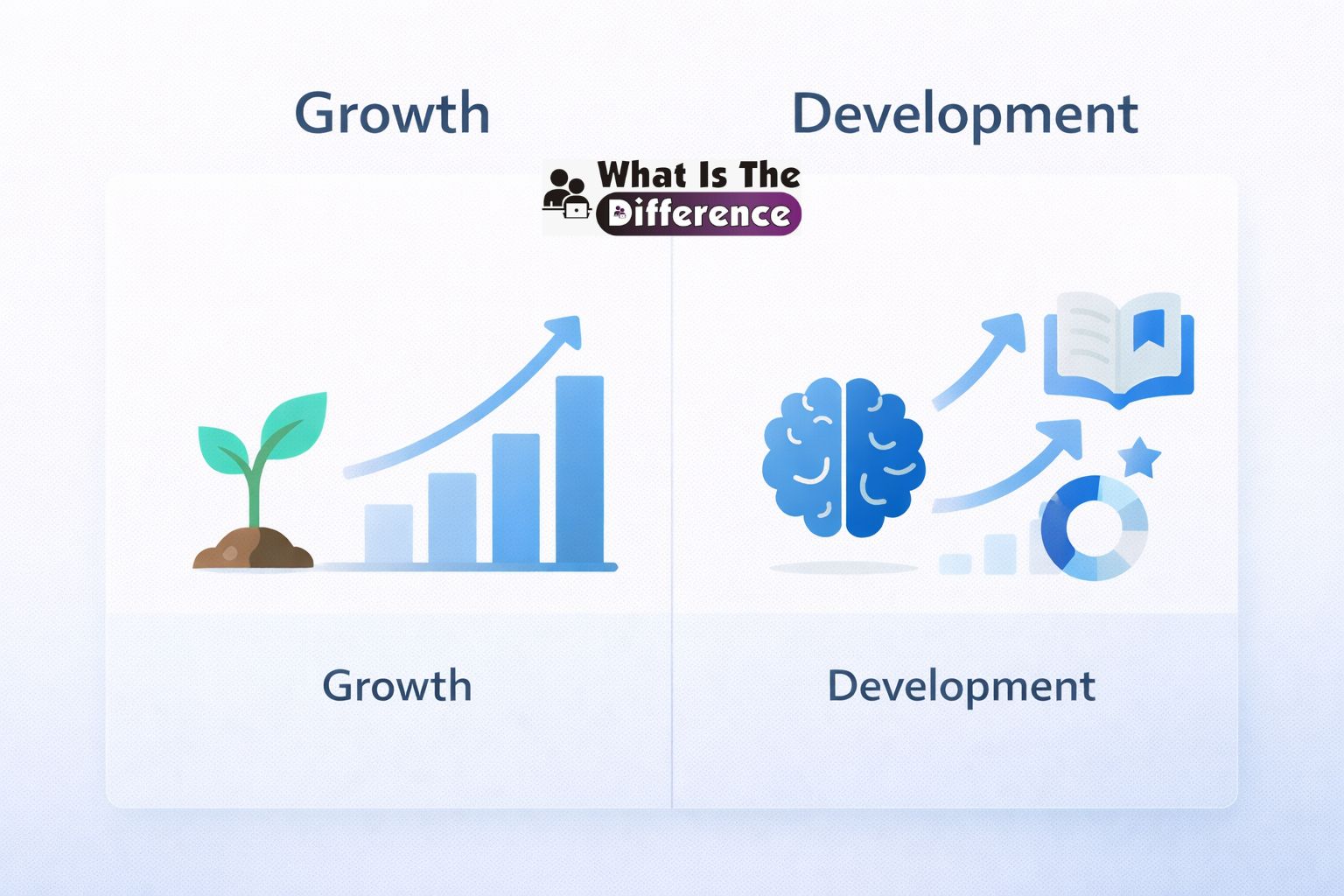
Growth refers to an increase in size, quantity, or number. It is a physical and measurable change that can be tracked over time.
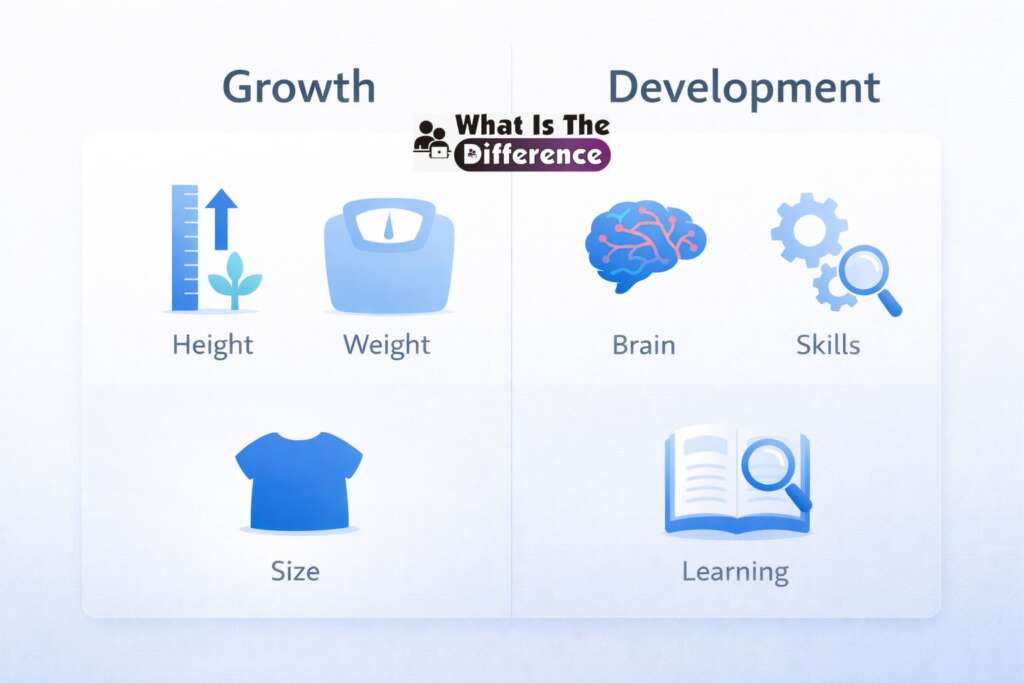
For example, when a child gains height or weight, that is growth. Similarly, when a company increases its revenue or a country’s economy expands, it is also considered growth.
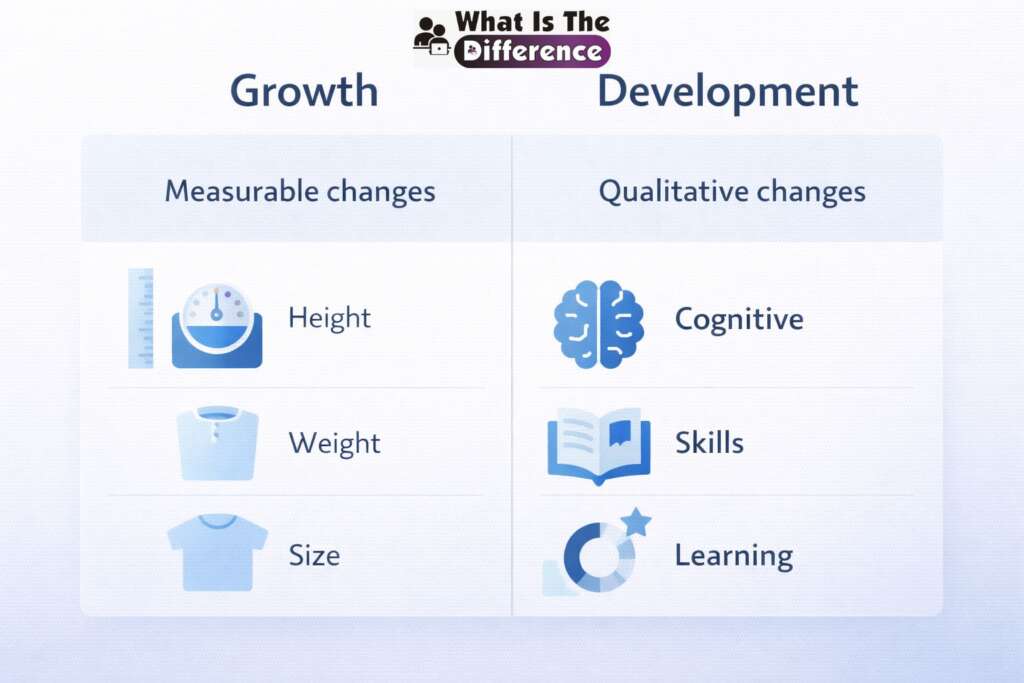
The key feature of growth is that it is quantitative, meaning it can be measured using numbers.
What Is Development?
Development, on the other hand, is about overall improvement and progress. It includes changes in skills, abilities, knowledge, and quality of life.
For instance, when a child learns to speak, think critically, or build relationships, that is development. These changes are not always measurable with numbers but are clearly visible in behavior and capability.
Development is qualitative, meaning it focuses on the quality of change rather than just size or amount.
What Is the Difference Between Growth and Development?
Understanding wwhat is the difference between growth and development becomes easier when you compare them directly.
Key Differences at a Glance
- Growth is about size or quantity
- Development is about improvement and progress
Growth is limited to physical or numerical increase, while development is broader and includes mental, emotional, and social aspects.
Measurement and Evaluation
One of the clearest differences is how each is measured.
- Growth can be measured in numbers like height, weight, or income
- Development is observed through changes in skills, behavior, or quality of life
For example, a student may grow in knowledge (more information), but development happens when they can apply that knowledge effectively.
Scope and Impact
Growth has a narrower scope. It focuses on one dimension, usually physical or numerical change.
Development, however, is continuous and multidimensional. It affects various aspects such as thinking ability, emotional maturity, and social interaction.
Dependency Between Growth and Development
Growth and development are related, but not the same.
- Growth can support development
- Development does not always require growth
For example, a person may not grow physically but can still develop intellectually or emotionally.
Types of Growth and Development
To understand the concept more deeply, it helps to look at different types.
Physical Growth
This includes changes in body size, height, weight, and structure. It is most visible during childhood and adolescence.
Cognitive Development
Cognitive development refers to improvements in thinking, learning, and problem-solving skills. It continues throughout life.
Emotional and Social Development
This involves understanding emotions, building relationships, and improving communication skills.
Economic Growth vs Economic Development
In economics, the difference becomes even clearer:
- Economic growth refers to an increase in a country’s output or income
- Economic development focuses on improving living standards, education, and healthcare
For a deeper understanding of how development differs from simple numerical growth, you can explore this concept further in .
How to Understand Growth and Development Easily
If you still find the difference confusing, here’s a simple way to break it down.
Step-by-Step Explanation
- Look at whether the change is physical or measurable
- Check if it involves skills, behavior, or improvement
- Ask if numbers can fully explain the change
If the answer is numbers, it’s growth. If it’s about overall progress, it’s development.
Quick Rule to Remember
A simple way to remember:
- Growth = Increase in size
- Development = Improvement in ability
This one-line rule can help you quickly identify the difference in exams or real life.
Real-Life Examples of Growth vs Development
Example 1: Child Development
A child gaining height and weight shows growth. But when the same child learns to speak, think, and interact, that is development.
Example 2: Education
A student memorizing more facts shows growth in knowledge. However, when they understand concepts and apply them, that is development.
Example 3: Economy
A country increasing its GDP shows growth. But when citizens experience better healthcare, education, and living standards, that is development.
Why Understanding the Difference Matters
Knowing wwhat is the difference between growth and development is more important than it seems.
It helps students perform better in exams, especially in subjects like biology, psychology, and economics. It also improves real-world understanding, allowing you to analyze progress more accurately.
For example, a business may grow financially but fail to develop in terms of customer satisfaction or innovation.
To explore similar concept-based comparisons, you can read this detailed guide on .
Tips to Remember the Difference
Use Simple Keywords
Think of growth as measurable change and development as overall improvement.
Focus on Long-Term Change
Growth often happens over a limited period, but development is continuous and lifelong.
Connect With Real Life
Relate the concept to everyday situations like learning, health, or career progress.
Common Mistakes to Avoid
Many people misunderstand these concepts because they:
- Assume both terms mean the same thing
- Focus only on physical changes
- Ignore qualitative improvements
- Use the terms interchangeably
Avoiding these mistakes will give you a clearer understanding.
Understanding the Concept for Practical Use
If your goal is to apply this knowledge, focus on identifying both aspects together.
For example, in personal growth, you may increase your income (growth), but true development happens when you improve your skills, mindset, and decision-making ability.
This approach helps you evaluate progress in a more meaningful way.
What Is the Difference Between Semaglutide and Tirzepatide for Weight Loss
FAQs
What is the main difference between growth and development?
Growth refers to measurable increase, while development focuses on overall improvement in abilities and quality.
Can growth happen without development?
Yes, growth can occur without development. For example, gaining weight without improving health.
Is development possible without growth?
Yes, development can happen without physical growth, such as improving skills or knowledge.
Why is development broader than growth?
Because it includes multiple aspects like mental, emotional, and social progress, not just physical change.
How are growth and development related?
Growth can support development, but development goes beyond growth.
Which is more important, growth or development?
Development is generally more important because it reflects overall progress and quality of life.
Conclusion
So, wwhat is the difference between growth and development? The answer lies in understanding that growth is about increase, while development is about improvement.
Growth can be measured, but development must be observed. Growth may stop at some point, but development continues throughout life.
When you understand this difference clearly, you not only improve your academic knowledge but also gain a better perspective on personal and professional progress.