When students first begin learning physics, one of the most common questions they ask is what is the difference between mass and weight. In everyday conversation, people often use these two terms as if they mean the same thing. For example, someone might say their “weight” is 70 kilograms. From a scientific perspective, however, that statement is not entirely accurate.
Mass and weight are closely related concepts, but they describe different physical properties. Understanding the distinction is important because it forms the foundation for many topics in physics, including gravity, motion, and energy.
In simple terms, mass describes how much matter an object contains, while weight describes the force of gravity acting on that mass. Although these ideas seem similar, they behave differently in various environments, such as on the Moon, in space, or on another planet.
This article explains the concepts in a clear and practical way so readers can easily understand what is the difference between mass and weight and why this distinction matters in science and everyday life.
BIO
| Feature | Mass | Weight |
|---|---|---|
| Definition | Amount of matter in an object | Force of gravity acting on an object |
| Nature | Fundamental property of matter | Result of gravitational pull |
| Depends on Gravity | No | Yes |
| Changes with Location | Does not change | Changes with gravity |
| SI Unit | Kilogram (kg) | Newton (N) |
| Measurement Tool | Balance scale | Spring scale |
| Type of Quantity | Scalar quantity | Vector quantity |
| Scientific Formula | No direct formula | W = m × g |
| Value on Earth vs Moon | Same everywhere | Different on each planet |
| Relation to Matter | Directly related to matter | Result of gravity acting on mass |
| Behavior in Space | Remains constant | Can become very small |
| Role in Physics | Determines inertia | Represents gravitational force |
Understanding the Basic Idea of Mass
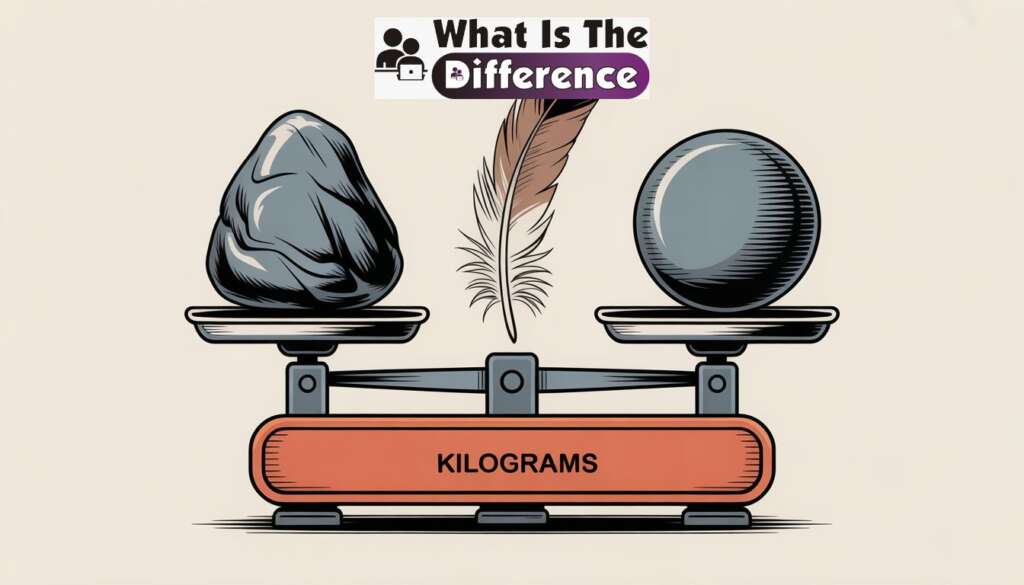
Mass is one of the most fundamental properties of matter. Every physical object in the universe possesses mass, from tiny particles to massive planets.
In physics, mass refers to the amount of matter contained in an object. It is closely related to the number and type of atoms that make up that object.
For example, a rock, a book, and a human body all have mass because they are made of matter. The more matter something contains, the greater its mass.
Another important characteristic of mass is that it is constant. It does not change depending on where an object is located. Whether an object is on Earth, on the Moon, or floating in space, its mass remains the same.
Measurement of Mass
Mass is measured using standard units in the International System of Units (SI). The most common unit is the kilogram (kg), although grams and milligrams are also used for smaller quantities.
Scientists measure mass using instruments such as:
- Balance scales
- Digital laboratory balances
- Inertial balances
These tools compare the mass of an object to a known reference, allowing scientists to determine its mass accurately.
Mass and Inertia
Mass also plays an important role in the concept of inertia. In physics, inertia refers to an object’s resistance to changes in motion. Objects with larger mass are harder to accelerate or stop than objects with smaller mass.
For instance, pushing a small chair across the floor requires much less effort than pushing a heavy sofa. The difference occurs because the sofa has greater mass and therefore greater inertia.
Understanding the Basic Idea of Weight
While mass describes the amount of matter in an object, weight describes the force that gravity exerts on that object.
Gravity is the natural force that pulls objects toward each other. On Earth, gravity pulls objects toward the center of the planet. Because of this gravitational attraction, every object with mass experiences weight.
In scientific terms, weight is defined as the gravitational force acting on an object’s mass.
Units Used to Measure Weight
Since weight is a force, its SI unit is the newton (N) rather than kilograms.
However, in everyday life people often use kilograms or pounds when referring to weight. This happens because common scales measure the force of gravity acting on the body and convert it into a value expressed in kilograms.
The Role of Gravity
Weight depends directly on gravity. If gravity becomes stronger or weaker, weight changes accordingly.
This relationship is expressed by the scientific formula:
W = m × g
Where:
- W represents weight
- m represents mass
- g represents gravitational acceleration
On Earth, the value of gravitational acceleration is about 9.8 meters per second squared. That means a mass of one kilogram experiences a gravitational force of approximately 9.8 newtons.
What Is the Difference Between Mass and Weight?
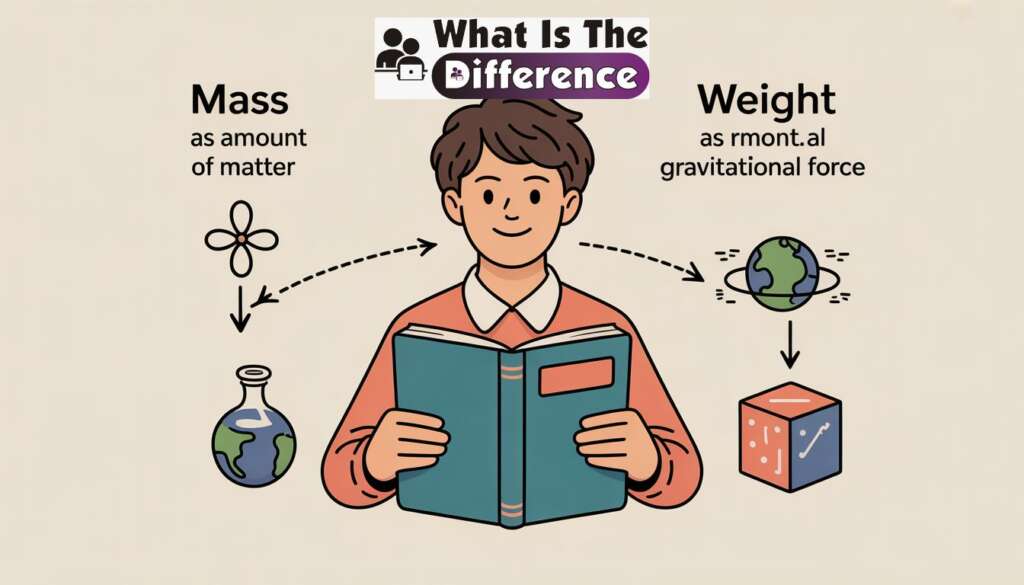
To clearly understand what is the difference between mass and weight, it is helpful to compare the two ideas directly.
Mass is an inherent property of an object. It tells us how much matter is present. Weight, on the other hand, is the gravitational force that acts on that mass.
One of the key distinctions is that mass remains constant, while weight changes depending on the strength of gravity.
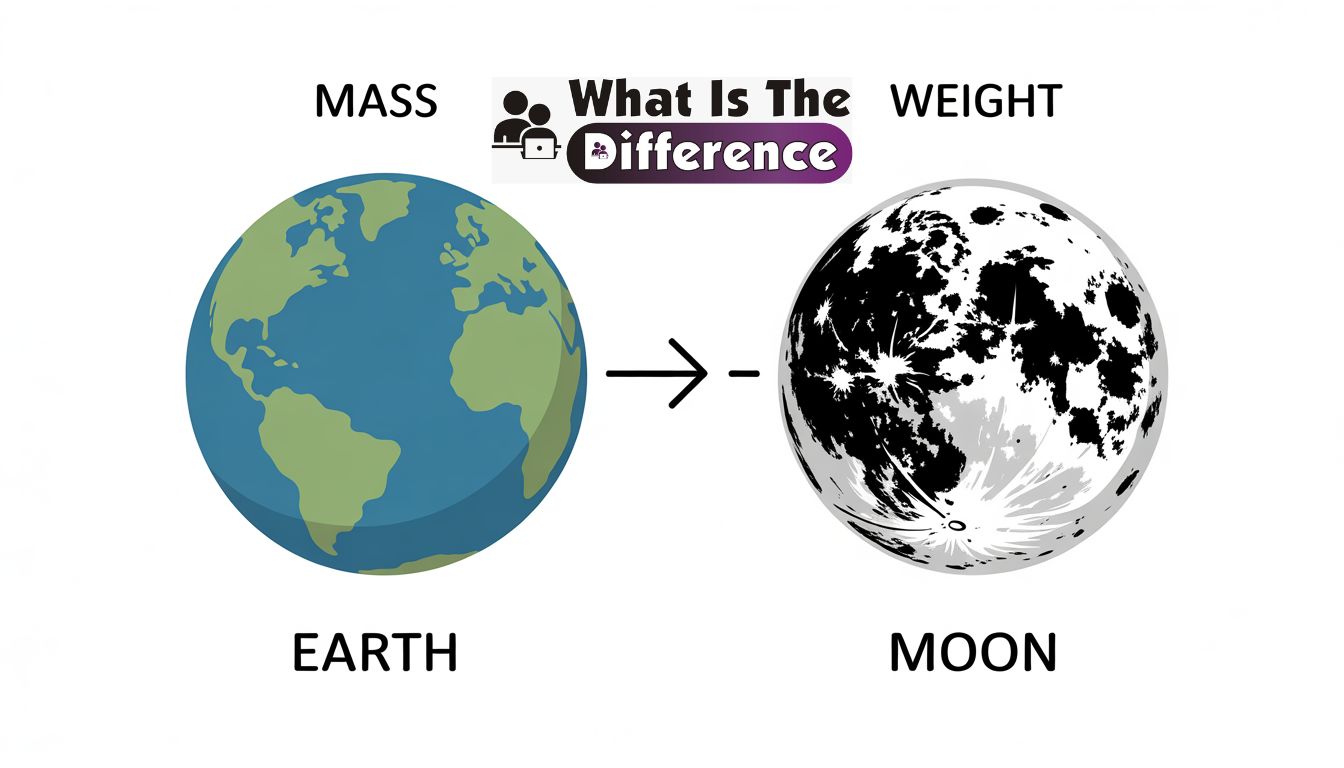
For example, imagine an astronaut traveling from Earth to the Moon. The astronaut’s mass remains exactly the same because the amount of matter in their body does not change. However, the Moon’s gravity is weaker than Earth’s gravity, so the astronaut’s weight becomes smaller.
Another difference lies in measurement units. Mass is measured in kilograms, while weight is measured in newtons because it represents a force.
Understanding what is the difference between mass and weight helps clarify many physical phenomena, especially those related to gravity and motion.
Examples That Show the Difference Clearly
The difference between mass and weight becomes easier to understand when looking at real-world examples.
On Earth
When a person stands on Earth, gravity pulls them toward the ground. Their body has a certain mass, and Earth’s gravity acts on that mass to create weight.
If someone has a mass of 70 kilograms, their weight on Earth would be approximately 686 newtons because of Earth’s gravitational force.
On the Moon
The Moon’s gravity is about one-sixth of Earth’s gravity. As a result, a person who weighs 686 newtons on Earth would weigh only about 114 newtons on the Moon.
Despite this change in weight, their mass would remain exactly the same.
In Space
Astronauts floating in orbit often appear weightless. This phenomenon is known as microgravity. In this environment, astronauts still have mass, but the gravitational forces acting on them create a sensation of weightlessness because they are in continuous free fall around Earth.
These examples illustrate why understanding what is the difference between mass and weight is essential for fields such as space science and astronomy.
Comparison Between Mass and Weight
A simple comparison highlights the differences between the two concepts.
Mass represents the amount of matter in an object. Weight represents the force of gravity acting on that matter.
Mass is measured in kilograms and remains constant regardless of location. Weight is measured in newtons and varies depending on gravitational strength.
Mass is a scalar quantity, meaning it has magnitude only. Weight is a vector quantity because it includes both magnitude and direction.
In everyday situations on Earth, the difference may seem small because gravity is relatively constant. However, in scientific calculations and space exploration, distinguishing between mass and weight becomes very important.
Why Understanding the Difference Matters
Understanding what is the difference between mass and weight is more than just a theoretical exercise. It has practical importance in several scientific and technological fields.
Education and Physics Learning
Students studying physics must understand this difference to correctly interpret formulas and scientific experiments. Many laws of motion depend on mass, while forces such as gravity involve weight.
Engineering Applications
Engineers designing structures, vehicles, or machines must consider both mass and weight. For example, spacecraft engineers must account for different gravitational environments when designing rockets or satellites.
Space Exploration
In space missions, astronauts experience changes in weight but not in mass. Understanding these differences allows scientists to plan missions safely and accurately.
Everyday Understanding
Even in daily life, recognizing the distinction between mass and weight helps people better understand how scales work and why objects feel lighter or heavier in different environments.
Common Misconceptions About Mass and Weight
Because the two terms are often used interchangeably in everyday language, several misconceptions arise.
One common misunderstanding is that kilograms measure weight. In reality, kilograms measure mass, while weight should technically be measured in newtons.
Another misconception is that mass changes when someone travels to another planet. In truth, only weight changes because gravity is different in different locations.
People also sometimes assume that a scale measures mass directly. Most scales actually measure weight and then calculate mass based on Earth’s gravitational force.
Clarifying these misconceptions helps reinforce a deeper understanding of what is the difference between mass and weight.
How Students Can Easily Remember the Difference
Learning physics concepts becomes easier when simple memory techniques are used.
One helpful trick is to remember that mass is matter, while weight is gravity’s pull. If an object has matter, it has mass. When gravity acts on that mass, it creates weight.
Another useful method is to remember the formula W = m × g. This equation shows that weight depends on both mass and gravity.
Practical demonstrations can also help students understand the concept. For example, comparing how objects feel lighter on a spring scale when taken to higher altitudes illustrates how gravitational effects influence weight.
These techniques make it easier for learners to remember what is the difference between mass and weight and apply the concept in physics problems.
What Is the Difference Between Similar Topics? Understanding the Real Distinction
Conclusion
The question what is the difference between mass and weight is one of the most fundamental topics in physics. Although the two terms are often used interchangeably in everyday language, they represent different scientific concepts.
Mass describes the amount of matter in an object and remains constant regardless of location. Weight describes the force of gravity acting on that mass and changes depending on the strength of the gravitational field.
Understanding this distinction helps explain many physical phenomena, from how objects move to how astronauts experience weightlessness in space. It also forms the foundation for many areas of science, engineering, and space exploration.
Once the concepts are clearly understood, it becomes easier to appreciate the role that gravity plays in shaping the behavior of objects throughout the universe.