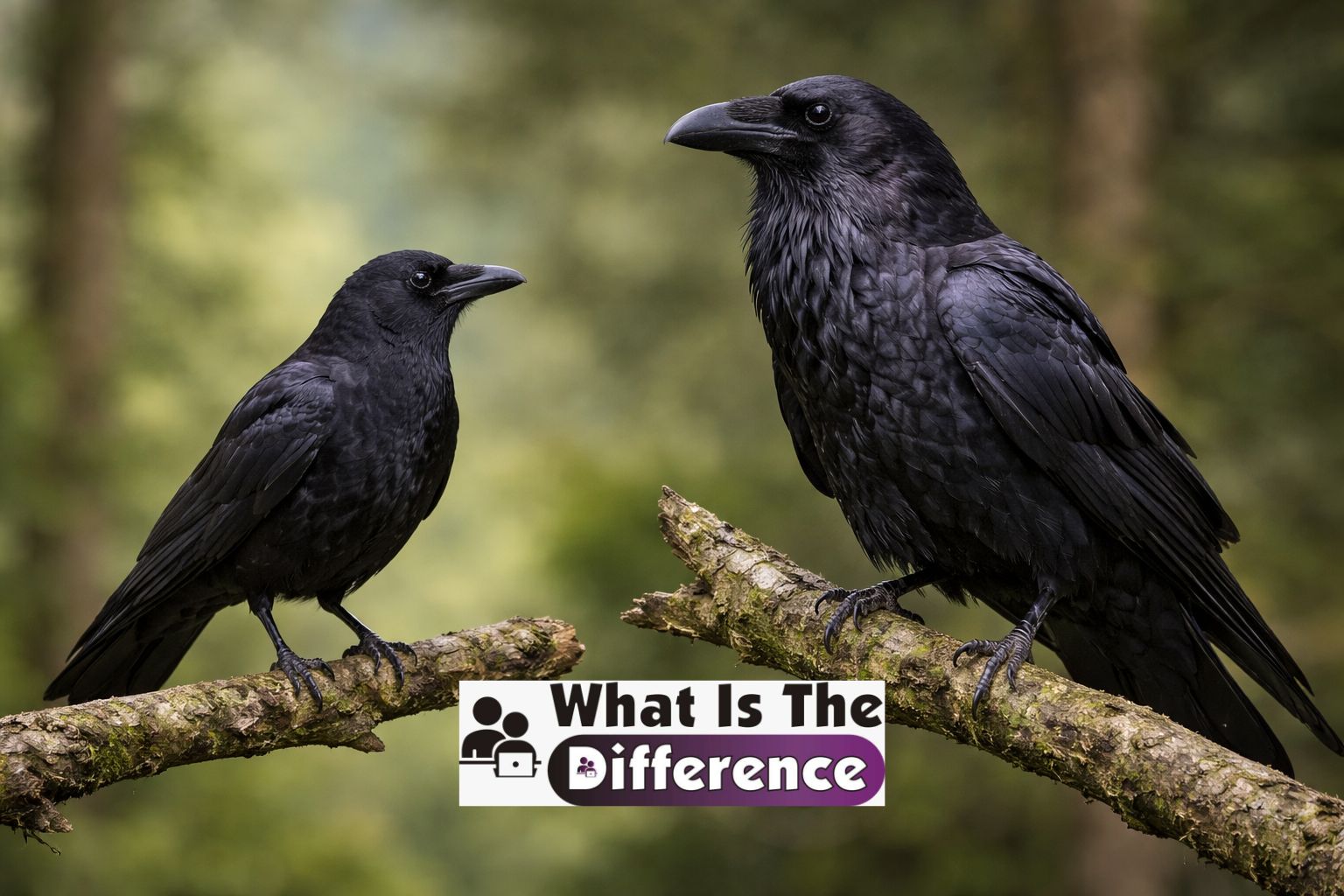
At first glance, crows and ravens look almost identical. Both are large black birds, often seen perched on trees, flying overhead, or scavenging for food. For many people, telling them apart feels nearly impossible.
But if you look a little closer, the differences become clear. Size, sound, behavior, and even the way they fly can reveal which bird you are looking at. This guide explores what is the difference between a crow and a raven in a simple, practical, and well-explained way.
By the end, you will not only understand the differences but also feel more confident identifying them in real life.
BIO
| Feature | Crow | Raven |
|---|---|---|
| Size | Smaller | Larger |
| Wingspan | Shorter | Wider |
| Beak Shape | Slim and straight | Thick and curved |
| Throat Feathers | Smooth | Shaggy |
| Voice | Sharp “caw” | Deep croak |
| Tail Shape | Fan-shaped | Wedge-shaped |
| Flight Style | Steady flapping | Gliding and soaring |
| Behavior | Social, in groups | Solitary or in pairs |
| Habitat | Cities and towns | Remote, wild areas |
| Intelligence | Highly intelligent | Equally intelligent |
| Diet | Omnivore, scavenger | Omnivore, more opportunistic |
| Common Sight | Very common | Less common |
What Are Crows and Ravens?
Crows and ravens belong to the same bird family, known as Corvidae. This family is famous for intelligence. These birds are not just survivors, they are problem-solvers, capable of memory, communication, and even basic reasoning.
Crows are generally smaller and more common, especially around human settlements. Ravens, on the other hand, are larger and often found in wilder or less crowded areas.
Despite their similarities, they are separate species with distinct traits. Understanding those traits is key to answering the question: what is the difference between a crow and a raven.
Main Differences Between a Crow and a Raven
Before diving into details, here is the core idea.
Ravens are bigger, deeper-voiced, and more solitary. Crows are smaller, louder, and more social.
From this foundation, we can explore each difference in more detail.
Size and Physical Appearance
One of the easiest ways to tell these birds apart is their size.
Ravens are significantly larger than crows. In fact, a common raven can grow to around 60 centimeters in length with a wide wingspan, making it one of the largest perching birds.
Crows are smaller, lighter, and more compact in comparison.
The beak also gives a strong clue. Ravens have thicker, more curved beaks, while crows have slimmer and straighter ones.
Another noticeable feature is the throat. Ravens often have shaggy throat feathers that look slightly messy or ruffled. Crows, in contrast, have smoother and more uniform feathers.
When you see a large, heavy-looking black bird with a strong beak and rough throat feathers, you are likely looking at a raven.
Voice and Sounds
Sound is one of the most reliable ways to identify these birds.
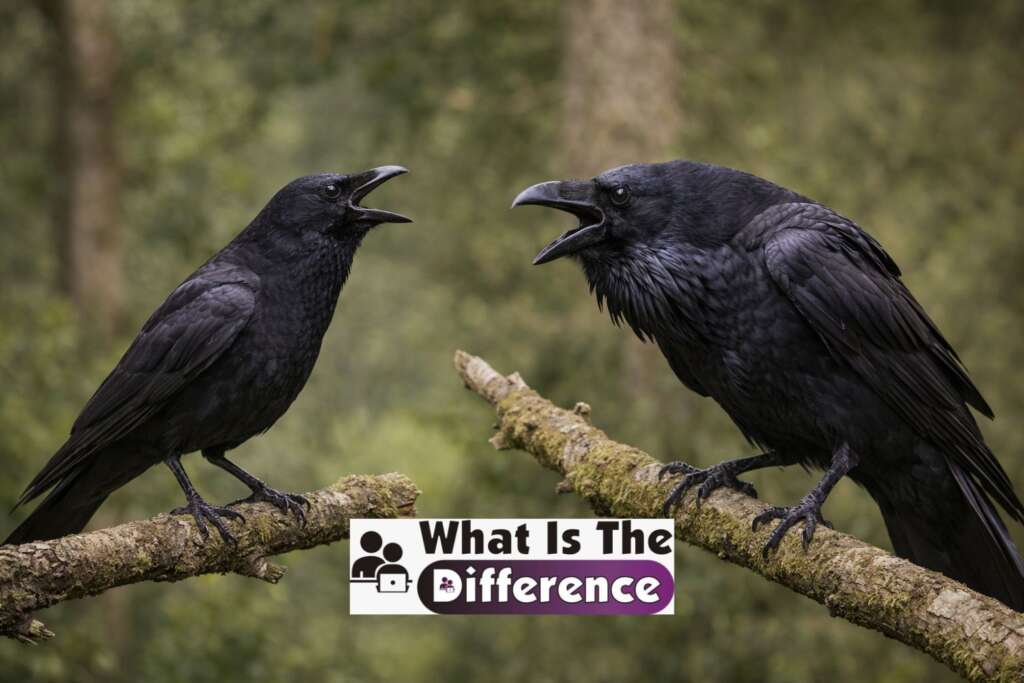
Crows are known for their classic “caw” sound. It is sharp, clear, and easy to recognize.
Ravens sound very different. They produce deep, croaking calls that feel heavier and more resonant.
If you hear a harsh “caw-caw,” it is almost certainly a crow. If the sound is lower, rougher, and more like a croak, it is likely a raven.
This difference alone often answers the question of what is the difference between a crow and a raven when you cannot see the bird clearly.
Tail Shape and Flight Style
Another strong visual clue appears when the bird is flying.
Crows have a fan-shaped tail. When they spread their tail feathers in the air, it looks rounded and even.
Ravens have a wedge-shaped or diamond-like tail. The middle feathers are longer, creating a pointed shape.
Flight behavior also differs.
Crows flap their wings more frequently and move with steady, active flight. Ravens tend to glide and soar, using air currents with less effort.
If you see a bird soaring smoothly with minimal flapping, it is likely a raven. If it is flapping steadily and moving in a direct path, it is probably a crow.
Behavior and Intelligence
Both birds are extremely intelligent, but their behavior differs in noticeable ways.
Crows are highly social. They often gather in large groups, sometimes called “murders.” These groups can include dozens or even hundreds of birds.
Ravens are more independent. They are usually seen alone or in pairs rather than large flocks.
In terms of intelligence, both species are remarkable. Crows are known for recognizing human faces and remembering threats, while ravens show advanced problem-solving abilities.
Their intelligence is not just impressive, it is one of the reasons they have adapted so well to different environments.
Habitat and Where They Live
Where you see the bird can also help identify it.
Crows are commonly found in cities, towns, farmland, and parks. They thrive in areas where humans live and often rely on human activity for food.
Ravens prefer more remote environments. They are often found in mountains, forests, deserts, or open countryside.
There are places where both birds can be found together, but generally, crows are more urban and ravens are more wild.
Diet and Feeding Habits
Both crows and ravens are omnivores. They eat a wide range of foods, including insects, small animals, fruits, and human leftovers.
Crows are often seen scavenging in urban areas, searching through garbage or feeding in open spaces.
Ravens also scavenge but are more opportunistic. They may hunt small animals, steal food, or feed on larger carcasses.
Their diets overlap heavily, but ravens tend to handle larger food sources due to their size and strength.
Lifespan and Breeding
Both birds can live surprisingly long lives, especially in the wild.
Crows typically live several years, while ravens can live even longer due to their larger size and adaptability.
In terms of breeding, both species build nests and raise their young carefully. However, ravens often choose more secluded nesting locations, such as cliffs or tall trees.
Crows are more comfortable nesting closer to human environments.
Cultural Meaning and Symbolism
Crows and ravens have played important roles in human culture for centuries.
Crows are often associated with mystery, intelligence, and sometimes mischief. In many cultures, they are seen as clever and adaptable creatures.
Ravens carry deeper symbolic meanings. They are often linked to mythology, wisdom, and sometimes death or transformation. Their presence in ancient stories and legends has made them one of the most symbolic birds in human history.
These cultural associations add another layer to understanding what is the difference between a crow and a raven beyond just physical traits.
How to Tell the Difference Quickly
If you only have a few seconds to decide, focus on these simple clues.
Look at the size first. Bigger usually means raven.
Listen to the sound. A sharp “caw” points to a crow, while a deep croak suggests a raven.
Watch the tail shape during flight. A fan shape means crow, and a wedge shape means raven.
Observe behavior. Large groups indicate crows, while a lone bird or pair often indicates ravens.
These quick checks can help you identify the bird even from a distance.
Common Mistakes People Make
Many people confuse crows and ravens because they rely only on color.
Both birds are black, so color alone is not helpful.
Another common mistake is judging size without comparison. Without another bird nearby, it can be hard to tell how large one bird really is.
Ignoring sound is also a mistake. Their calls are one of the clearest differences, yet many people overlook this detail.
Learning to combine multiple clues is the best way to avoid confusion.
Quick Comparison Table
| Feature | Crow | Raven |
|---|---|---|
| Size | Smaller | Larger |
| Beak | Slim and straight | Thick and curved |
| Sound | Sharp “caw” | Deep croak |
| Tail Shape | Fan-shaped | Wedge-shaped |
| Flight Style | Frequent flapping | Gliding and soaring |
| Throat Feathers | Smooth | Shaggy |
| Social Behavior | Large groups | Pairs or alone |
| Habitat | Cities and towns | Remote areas |
| Wingspan | Shorter | Wider |
| Body Shape | Slim | Bulkier |
| Behavior | Highly social | More independent |
| Presence | Very common | Less common |
Conclusion
Understanding what is the difference between a crow and a raven becomes much easier once you know what to look for.
It is not just about size or color. It is about a combination of features, sound, behavior, and environment.
Crows are smaller, louder, and more social. Ravens are larger, deeper-voiced, and more solitary. These differences may seem subtle at first, but once you notice them, they become obvious.
The next time you see a black bird in the sky or hear a call in the distance, take a moment to observe. With a bit of attention, you will quickly know whether you are looking at a crow or a raven.
And once you can tell them apart, you will start to appreciate just how fascinating both birds truly are.
What Is the Difference Between a Motel and a Hotel? Explained Clearly
FAQs
What is the easiest way to tell a crow from a raven?
The quickest way is to listen to the sound and observe the size. Crows make a sharp “caw” and are smaller, while ravens produce a deeper croak and appear noticeably larger with a heavier build.
Are ravens smarter than crows?
Both birds are extremely intelligent and belong to the same family. Ravens may show more advanced problem-solving in some situations, but crows are equally impressive, especially in memory and social intelligence.
Do crows and ravens live in the same places?
They can share some regions, but their preferences differ. Crows are more common in cities and towns, while ravens usually prefer remote areas like forests, mountains, or open countryside.
Which bird is bigger, a crow or a raven?
Ravens are significantly larger than crows. They have a bigger wingspan, thicker beak, and a more powerful overall appearance, which makes them easier to identify when seen up close.
Why do people confuse crows and ravens so often?
People often confuse them because both birds are black and belong to the same family. Without noticing details like sound, tail shape, or behavior, it is easy to mistake one for the other.